How Long Is a Contractor Liable for Work in PA? Berks Guide
Found a defect after the job? How Pennsylvania contractor warranties work, the deadlines to bring a claim, and what to gather, for Berks homeowners.
There's no single number for how long a contractor is liable in Pennsylvania: a contractor's written warranty lasts as long as the promise says, and no state law requires a home improvement contractor to give one or sets a minimum. The law sets its own deadlines to file a lawsuit, generally two to six years depending on the kind of claim. An outer limit generally ends construction claims twelve years after the work was finished. This is general information, and which deadline fits your own problem is a question for a lawyer. If you need someone to look at the work in the meantime, there are general contractors in Berks County who can see what's causing it.
What does a contractor's warranty cover in Pennsylvania?
A written warranty is the contractor's own promise in writing to fix problems for a set time. No Pennsylvania law makes a home improvement contractor give one, and none sets a minimum length. The state's home improvement law lists thirteen things a contract has to include, and a warranty isn't one of them.
What the law does care about is a promise once it's on paper. Under the state's consumer protection law, it's an unfair practice for a contractor to fail to honor the terms of a written warranty, or to do repairs or improvements of a lower quality than what was agreed in writing.
And the paper varies a lot. Berks contractors that state a warranty on their own websites give terms anywhere from one year to "lifetime." Some of the longest are roofers', and some of those numbers include a shingle maker's program on the materials, alongside the contractor's own coverage on the work. Some warranties cover labor only. Some cover only the person who bought the job. Some make yearly inspection and maintenance the owner's job and don't cover damage from neglect. Some remodelers list one to five years, and your contract is where to confirm what yours says.
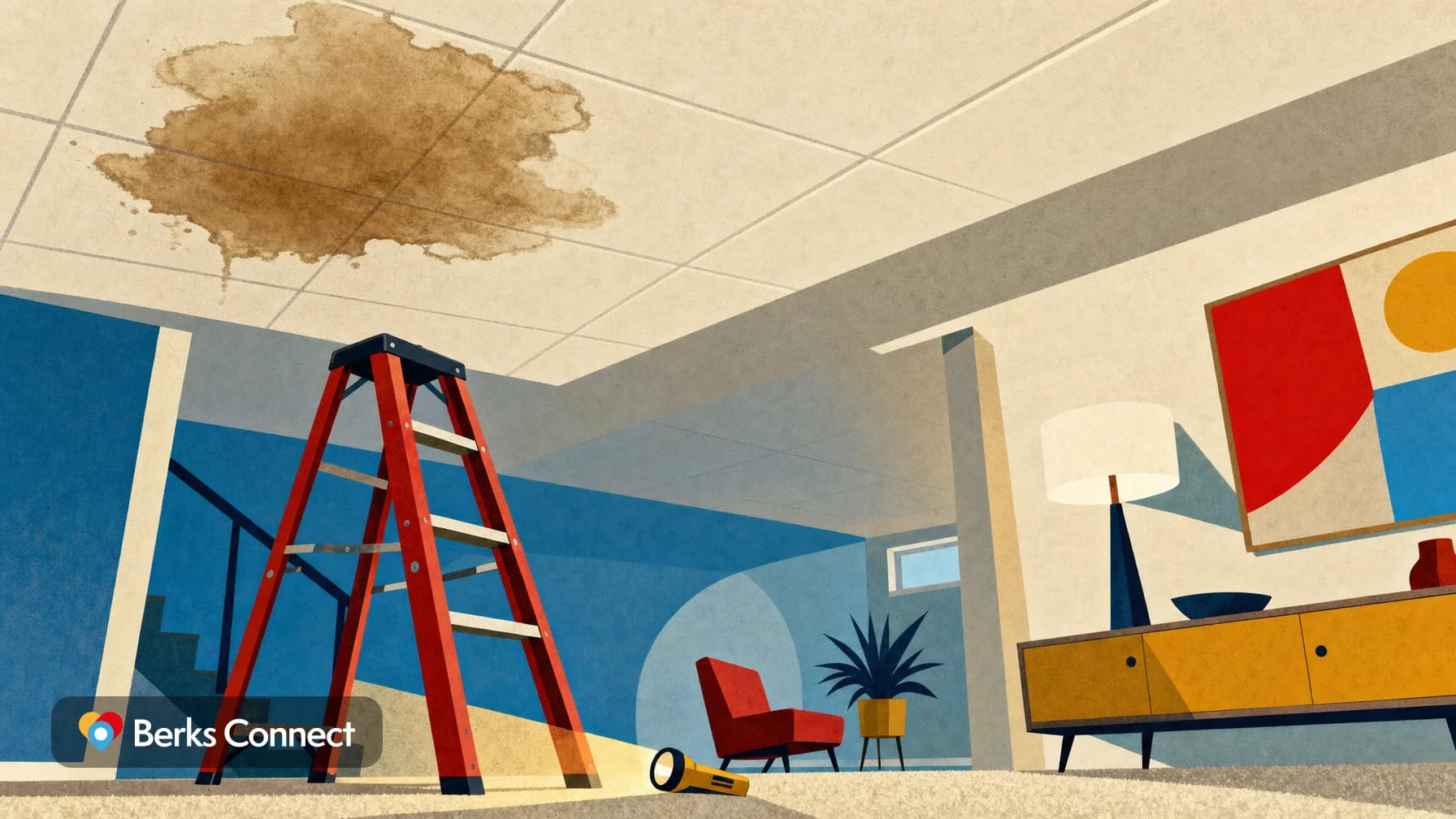
Say it's the new shower leaking into the ceiling a year after the remodel. Before I'd think about the law, I'd pull the contract and any warranty sheet and read three things: how long the promise runs, what it covers (labor, materials, or both), and what conditions it sets. That's what the contractor promised, in the contractor's own words.
So what if the contractor tells you the one-year warranty is over? If the warranty's term has run, that's the end of the contractor's own promise. The law's deadlines are separate, and they run on their own clocks, so a warranty that has run out isn't the same thing as a deadline that has passed. Whether a claim over the work is still open is the question to take to a lawyer, along with the contract, the warranty and your dates.
If you're reading this before a job instead of after one, ask what the warranty covers and for how long, and get it in writing before you sign. You'll find the rest of what to ask in our guide to hiring home services in Berks County.
Pennsylvania's deadlines to bring a claim about a contractor's work.
A statute of limitations is the deadline to bring a claim, and bringing a claim means filing a lawsuit. A statute of repose is the outer limit that ends a claim no matter when the problem shows up. The table shows the ones that come up with a contractor's work:
| Kind of claim | Deadline in Pennsylvania law | When the clock generally starts |
|---|---|---|
| A claim for damage caused by negligence | 2 years | Generally when the damage is done. The discovered-or-should-have-discovered rule can delay that. |
| A claim on a written contract | 4 years | When the contract is broken, which for building work is generally when the faulty work was done. For a hidden defect in construction, Pennsylvania's Supreme Court has said it starts when the owner knew, or with reasonable care should have known. |
| A claim under the state's consumer protection law | 6 years, the general deadline an appeals court has applied to these claims | Depends on the claim. |
| Any construction claim, at the outside | 12 years | When the construction is completed. Finding the problem later doesn't extend it. |
These are Pennsylvania's general deadlines to file a lawsuit as of 2026. A written contract can set a shorter one, and which deadline fits a particular problem is a question for a lawyer.
A written contract can change two things on that table. It can set a shorter deadline than the law's, as long as it's not unreasonably short. It can also say when claims start to count, for example when the work is essentially finished. That's why the claims clause in your contract matters as much as the warranty. Whichever of the table's shorter deadlines applies, the twelve-year limit is the latest a construction claim can generally be brought.
When does the clock start on a hidden defect?
A claim on a contract generally starts counting from the time of the breach, meaning when the contract is broken. Hidden problems are different. Pennsylvania's Supreme Court has said that when a defect in construction is hidden, the clock doesn't start until the owner became aware of it, or with reasonable care should have.
When did you know, or when should you have known? That's usually a question a jury decides. Outside hidden construction defects, Pennsylvania's appeals courts haven't all agreed on whether a written-contract claim can start late, so whether the clock started late on a given job is one of the questions to put to a lawyer.
How long is a contractor liable for work in PA at most?
A claim over a flaw in how an improvement to a home was designed or built, or over damage it caused, has to be brought within twelve years after the construction was finished. Pennsylvania's Supreme Court has said that the rule about when a problem was discovered, and the usual reasons a deadline can be paused, can't stretch this limit. Once it passes, there's no claim left against the people who designed or built it, apart from the exception below.
There's one exception, for a late injury. If an injury or a death happens more than ten years but within twelve years after the work was finished, the claim can be brought within the usual deadline for that kind of claim, though never more than fourteen years after the work was finished.
What to do in Berks County when a contractor's work fails.
Start a file. The Attorney General's consumer office asks people to keep copies of the contract, any warranties, sales receipts, repair orders and canceled checks, along with a record of who you spoke with and what was done. Take pictures too. If it's a stain on the ceiling under the shower, photograph the stain; if it's a deck pulling away from the house, photograph where it meets the house.
Then put the request to the contractor in writing. Try to work it out with them first, and say exactly what you want done and how long you're willing to wait. If you talk on the phone, follow the call with a letter sent by certified mail with a return receipt, so you can prove it arrived. Keep your notes and a copy of every letter.
If that doesn't settle it, the Attorney General's Bureau of Consumer Protection takes complaints at 1-800-441-2555 from inside Pennsylvania, or online. Send copies of your papers and pictures with the complaint, never the originals. The office tries mediation, but the contractor doesn't have to take part, and the result isn't binding. The office can't act as your lawyer. If you want to check the contractor's registration first, you can use our guide to verifying a contractor's registration.
This is general information; a lawyer is the person who can tell you where your own claim stands, and the file you've built is what they'll want to see. The Berks County Bar Association's Lawyer Referral Service is at 610-375-4591, and MidPenn Legal Services' Reading office gives free legal help to people who qualify (apply at 1-800-326-9177). For more ways to find one, see our guide to finding a lawyer in Berks County.
And if the problem is still getting worse, like water coming through a ceiling or a deck pulling away, you'll want someone to look at it either way. There are general contractors in Berks County who can tell you what's causing it.
Questions Berks homeowners ask about contractor warranties.
What if a contractor won't honor the warranty?
Under Pennsylvania's consumer protection law, it's an unfair practice to fail to honor the terms of a written warranty, meaning what it promised, for as long as it promised it. The paper trail shows what was promised and when: the contract, the warranty, receipts, repair orders, pictures, and a certified letter that says what you want done and by when. A complaint goes to the Attorney General's Bureau of Consumer Protection, which tries mediation.
Is there an implied warranty of habitability in Pennsylvania?
For new homes, generally yes, unless the contract clearly disclaims it. An implied warranty is a promise the law reads into a new-home deal even when nobody wrote it down. Pennsylvania's Supreme Court has held that a builder who builds a new home and sells it promises that it's fit to live in and built in a reasonably workmanlike way, which the court said means reasonable under the circumstances, not perfect. An appeals court extended that to a builder hired to build a new house on the owner's own land. The court decisions that set this out are about newly built homes. Whether anything like it reaches a remodel or a repair is a question for a lawyer.
Does a condo or townhouse come with a warranty in Pennsylvania?
Many condominiums and planned communities, like townhouse developments with an association, come with a warranty written into state law. The developer warrants against structural defects for two years. A suit to enforce that developer's warranty has its own deadline: it has to start within six years after the warranty begins. That's the developer's warranty, not a remodeler's, and its deadline is separate from the consumer protection law's.
Does a contractor's warranty pass to the next owner?
Not always. Some written warranties cover only the original buyer, so read the paper. The implied warranty on a new home belongs to the buyer who contracted with the builder, and Pennsylvania's Supreme Court has held that a later buyer of the house can't recover under it.
Sources
- Pennsylvania General Assembly, Home Improvement Consumer Protection Act, 73 P.S. § 517.7(a): the thirteen things a home improvement contract must include, none of them a warranty
- Pennsylvania General Assembly, Unfair Trade Practices and Consumer Protection Law, 73 P.S. § 201-2(4)(xiv) and (xvi): failing to honor a written warranty, and work below the standard agreed in writing
- 42 Pa.C.S. § 5524(7), § 5525(a)(8), § 5527(b) and § 5501(a): the two-year period for a negligence claim, the four-year period on a written contract, the six-year catch-all, and a shorter time set by written agreement
- Superior Court of Pennsylvania, Gabriel v. O'Hara, 534 A.2d 488 (1987): six years for a claim under the consumer protection law
- 42 Pa.C.S. § 5536 and Supreme Court of Pennsylvania, Gidor v. Mangus (October 23, 2025): the 12-year outer limit, the 14-year cap for an injury in years 10 to 12, and that no discovery rule or tolling extends it
- Supreme Court of Pennsylvania, Romeo & Sons v. P.C. Yezbak & Son, 652 A.2d 830 (1995) and Fine v. Checcio, 870 A.2d 850 (2005): a contract claim runs from the breach, a hidden construction defect from when the owner knew or should have known, and discoverability as a jury question
- Daniel E. Cummins and Daniel E. Cummins Jr., "Appellate Courts Disagree on Whether the Discovery Rule Applies in Breach of Contract Actions," Pennsylvania Law Weekly (September 25, 2025): the appeals courts' different approaches on written contracts
- Superior Court of Pennsylvania, SpiriTrust Lutheran v. Wagman Construction, 2024 PA Super 80: a construction contract clause starting claims at substantial completion, and contract and negligence claims dated from the work itself
- Supreme Court of Pennsylvania, Elderkin v. Gaster, 288 A.2d 771 (1972), Superior Court, Groff v. Pete Kingsley Building, 543 A.2d 128 (1988) and Hosler v. Tweedlie, 2023 PA Super 223: the implied warranty of reasonable workmanship and habitability for new homes, reasonable rather than perfect
- Supreme Court of Pennsylvania, Conway v. Cutler Group, 99 A.3d 67 (2014): a later buyer can't recover under the builder's implied warranty
- 68 Pa.C.S. § 3411 and § 5411: the developer's two-year structural warranty for condominiums and planned communities, and the six-year limit to enforce it
- Pennsylvania Office of Attorney General, Consumer Complaint Form and Problem-Solving Tips (PDF, January 2026): the file of receipts, repair orders, warranties, canceled checks and contracts, the record of calls, copies not originals, 1-800-441-2555
- Pennsylvania Office of Attorney General, Bureau of Consumer Protection, "Mediation FAQs" (2023): pictures among the documents to send, and voluntary, non-binding mediation
- Pennsylvania Office of Attorney General, consumer complaint page: filing online, mediation, and that the mediation unit can't act as your lawyer
- Federal Trade Commission, "How To Avoid a Home Improvement Scam": trying the contractor first, the certified letter with a return receipt, notes and copies
- MidPenn Legal Services and its Locations page: free civil legal services for people who qualify, and the Reading office's application line, (800) 326-9177
- Berks County Bar Association, Find a Lawyer: the Lawyer Referral Service, 610-375-4591
- Berks contractors' own warranty pages, including a roofer's, a remodeler's, a home builder's and a commercial builder's (read October 6, 2026): the range of terms Berks contractors state, from one year to lifetime, and how makers' warranties on materials sit beside contractors' warranties on the work