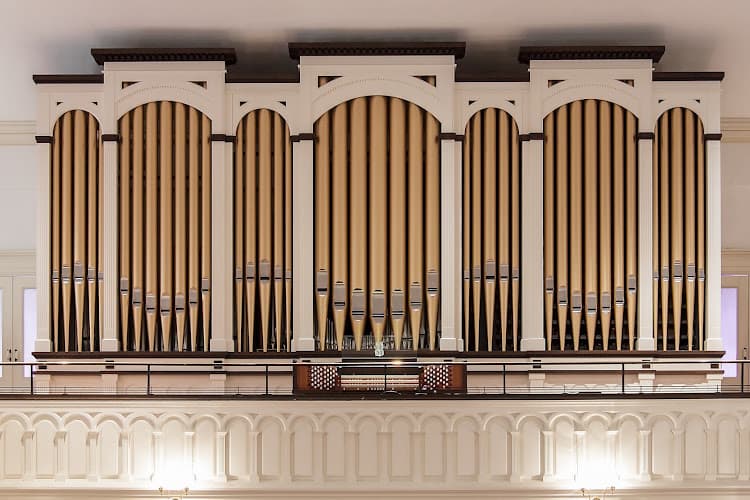
Patrick J Murphy & Associates is a pipe organ building and service firm based at 300 Old Reading Pike in Stowe, Pennsylvania, a community adjacent to Pottstown in the western part of Montgomery County. The company designs and constructs new pipe organs, rebuilds and restores existing instruments, and provides ongoing tuning and maintenance for churches, schools, concert venues, and private owners. It operates as a small business, with the owner personally involved in the design, voicing, and service work that carries the company name.
Unlike a conventional retail music store, the operation centers on a workshop rather than a sales floor. Pipe organs are not stock items; each instrument is built or adapted for a specific room, a specific liturgical or concert use, and a specific budget. As a result, the firm's work is measured in projects that can span months or years, and in service relationships with institutions that continue across decades.
New Instrument Design and Construction
New organ projects typically begin with an assessment of the building itself. Acoustics, ceiling height, reverberation time, sight lines, chancel or gallery placement, and the musical repertoire a congregation or school expects to play all influence the instrument's stoplist, scaling, and physical layout. From there the firm develops a specification, a casework and facade design, and a plan for wind supply, action, and console placement.
Work handled in connection with new instruments generally includes:
- Stoplist development and tonal design suited to the room and the intended repertoire
- Windchest construction, including electro-pneumatic and slider chest designs
- Casework, facade pipe arrangement, and impost and console joinery
- Blower and reservoir sizing, wind trunking, and tremulant regulation
- Console construction or rebuilding, with keyboards, stop controls, pedalboards, and combination systems
- On-site erection, tonal finishing, and voicing once the instrument is installed
Tonal finishing is the stage that distinguishes one builder's instrument from another. After assembly, each pipe is regulated in the room where it will be heard, adjusting speech, volume, and blend so that individual stops function both alone and in ensemble. This is slow, ear-driven work that cannot be completed in a shop, and it is the reason organ builders return to a site repeatedly during the final phase of a project.
Restoration, Rebuilding, and Additions
A significant share of the firm's work involves instruments already in place. Many American churches own organs built anywhere from the late nineteenth century through the mid twentieth century, and these instruments eventually require attention to leather, wiring, actions, or wind systems that have reached the end of their service life. Depending on the condition of the organ and the goals of the owner, the appropriate response may be a faithful restoration, a rebuild that retains the original pipework while replacing failed mechanisms, or an expansion that adds ranks and divisions to an instrument that has outgrown its role.
Typical restoration and rebuilding services include releathering reservoirs and pneumatics, repairing or replacing windchests, cleaning and repitching pipework, rebuilding or replacing consoles, upgrading control systems and combination actions, and relocating or revoicing existing ranks when a room is renovated. Firms in this field also frequently help owners evaluate used or surplus instruments, since a well-built organ from a closed building can sometimes be adapted for a new home at a lower cost than new construction.
Tuning and Maintenance Service
Routine service is the steady backbone of a pipe organ business. Organs respond directly to temperature and humidity, and most instruments are tuned at least twice a year, commonly before major seasons in the church calendar or ahead of concert dates. Service visits address more than pitch: ciphering notes, sluggish actions, dead stops, leaking pneumatics, blower noise, contact problems, and console electronics all tend to surface between scheduled tunings.
Patrick J Murphy & Associates maintains service relationships with institutions across its region, which for firms of this type generally extends outward from the home shop through southeastern Pennsylvania and into neighboring states. Regular maintenance agreements allow a technician to track an individual instrument's history over time, which is valuable when planning eventual repairs or a larger rebuild, since a known maintenance record helps owners budget and prioritize.
The Craft and the Workshop
Pipe organ building draws on several trades at once: cabinetry and fine woodworking, metalwork, leatherwork, electrical and control systems, and the musical discipline of voicing. A working organ shop therefore looks different from most instrument businesses, with erecting space tall enough to assemble a partially completed instrument, benches for chest and action work, and areas devoted to pipe repair and voicing. For those unfamiliar with the mechanics, seeing a windchest opened or a rank of pipes laid out on a bench explains a great deal about how the instrument produces sound and why service work requires specialized training.
Because the shop is a working production space rather than a showroom, anyone hoping to view a project in progress or discuss a potential job should contact the company in advance to arrange a time.
Who the Firm Works With
The client base for a builder of this kind is largely institutional. Congregations of many denominations form the core, along with schools, colleges, funeral homes, auditoriums, and occasional residential owners. Organists, music directors, building committees, architects, and acoustical consultants are all common points of contact during a project, and much of a builder's role involves translating musical goals into a technical proposal that a committee can understand, compare, and fund.
For organizations beginning this process, useful preparation includes gathering any documentation of the existing instrument, noting its builder and installation date, listing recurring problems, and identifying how the organ is used across services, rehearsals, weddings, funerals, and concerts.
Location and Practical Information
- Address: 300 Old Reading Pike, Suite 1D, Stowe, Pennsylvania 19464
- Telephone: +1 610-970-9817
- Website: www.pjmorgans.com
- Business type: pipe organ builder, restorer, and service provider
- Accessibility: wheelchair accessible parking lot
- Ownership: independently operated small business
The Stowe location sits along Old Reading Pike just west of Pottstown, an area easily reached from Route 422 and within convenient driving distance of Reading, Norristown, King of Prussia, and the greater Philadelphia area. Inquiries about new instruments, restoration estimates, tuning schedules, and service calls are handled by phone or through the company website, and appointments are recommended for shop visits or on-site consultations.