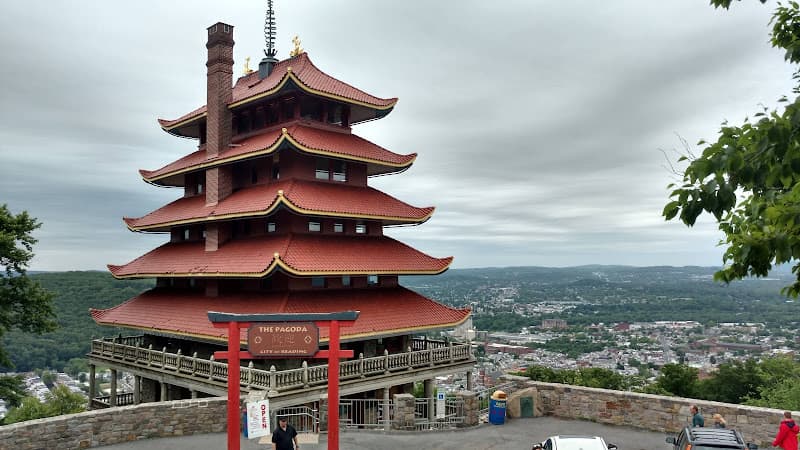
The Reading Pagoda sits at 98 Duryea Drive in Reading, Pennsylvania, perched on the western face of Mount Penn roughly 600 feet above the city below. Visible from much of Berks County and from a good stretch of Route 422, the seven story structure has served as Reading's unofficial emblem for more than a century, appearing on city seals, souvenirs, sports logos and countless photographs of the Schuylkill Valley. It is owned by the City of Reading, operated with the support of a volunteer preservation organization, and open to the public as a historical landmark and observation point.
Unlike most landmarks of its size, the Pagoda was never built to be a civic monument. Its origins lie in an early twentieth century real estate venture, and the building survives today because a series of owners and local volunteers decided it was worth keeping. That unusual backstory is part of what draws visitors up the mountain, alongside the architecture itself and the view across the city rooftops toward the Schuylkill River and the farmland beyond.
History
Construction began in 1906 and was completed in 1908 under William Abbott Witman Sr., a Reading businessman who had operated a quarry on the side of Mount Penn. The quarrying left a visible scar on the hillside, and the Pagoda was conceived in part as a way to cover and capitalize on that ground. Witman intended the building to function as a luxury resort hotel, complete with dining rooms and guest accommodations, served by a road winding up from the city.
The plan collapsed before it ever opened. The hotel was denied a liquor license, the financing fell apart, and the property passed through creditors. In 1911 it was conveyed to the City of Reading by Jonathan Mould and his wife Julia for a nominal sum, with the understanding that it would be preserved for public use. Since then it has been held in public ownership and has served variously as an observation deck, gift shop, tea room, broadcast site and community gathering place.
The Pagoda was added to the National Register of Historic Places in 1972. Over the decades it has undergone several significant restoration campaigns addressing the roof tiles, structural timbers, masonry and electrical systems, work carried out through a combination of municipal funding, grants and local fundraising. The red tile roofs and the exterior lighting scheme, which outlines the tiers after dark, have both been renewed as part of that ongoing maintenance.
Architecture and Design
The building rises about 72 feet from its foundation and is arranged over seven levels, each ringed by projecting eaves and topped with red tile. The design draws on Japanese and broader East Asian pagoda forms, though it was adapted by its builder rather than copied from a specific temple, and it incorporates American construction methods and materials of the period. Local legend has long held that the design was inspired by a castle in Japan, an account repeated in many histories of the building, though documentation of the exact source is thin.
Inside, a staircase climbs through the tiers to an upper observation level with windows looking out over Reading, West Reading, Wyomissing and the ridgelines to the west and south. Interpretive displays, photographs and historical material about the structure and about Reading itself are presented on the lower floors, and a small shop selling Pagoda themed merchandise has operated within the building during public hours.
One of the more notable objects housed at the site is a large bronze temple bell, reported to have been cast in Japan in the first half of the eighteenth century and brought to Reading in connection with the building's original furnishing. The bell has been rung on special occasions and remains one of the artifacts most often pointed out to first time visitors.
Getting There and Parking
The Pagoda is reached by Duryea Drive, a narrow mountain road that leaves the city street grid on Reading's east side and climbs Mount Penn through a series of switchbacks and tight curves beneath a canopy of hardwood forest. Drivers should take the grade slowly, watch for cyclists and pedestrians, and be aware that the road is shared with runners and hikers using the surrounding trail network. Skyline Drive continues along the ridge from the Pagoda toward the William Penn Memorial Fire Tower.
Parking is available at the summit in a lot adjacent to the building, with additional free street parking in the immediate vicinity and paid parking options in the area. Spaces at the top are finite, and the lot can fill during fair weather evenings, holidays and community events, so visiting earlier in the day or on a weekday generally makes the approach easier. Accessible parking is provided in the lot.
Planning a Visit
Useful points for anyone heading up the mountain:
- The site is suitable for children, and families frequently combine a stop here with a walk on the nearby trails or a drive along the ridge road.
- Access to the upper floors is by stairs only. Because of the building's historic construction, the entrance is not wheelchair accessible, though the grounds and the overlook area outside the building can be reached from the parking lot.
- The grounds, the exterior lighting and the viewpoint can be enjoyed from outside even when the interior is not open to the public.
- Conditions on the mountain run cooler and breezier than in the city, and the lot sits in open air, so a jacket is worth bringing on cool evenings.
- The surrounding Mount Penn Preserve contains an extensive network of hiking and mountain biking trails, several of which connect to the Pagoda grounds.
Role in the Community
The Pagoda functions as more than a lookout. It has hosted lighting ceremonies, fundraisers, cultural events, school visits and seasonal celebrations, and it appears regularly in local art, photography and civic branding. Volunteers and preservation advocates handle staffing, programming and fundraising for continued repairs, and public support through visits, donations and merchandise purchases contributes directly to the upkeep of a structure that has outlived the business plan that produced it. For residents and visitors alike, the building remains one of the clearest reference points on the Berks County skyline.