The Hill School is a private, coeducational college preparatory school located at 860 Beech Street in Pottstown, Pennsylvania. Serving students in grades nine through twelve along with a postgraduate year, the school operates as both a boarding and day institution, with the majority of its students living on campus. Its address places it roughly 40 miles northwest of Philadelphia in Montgomery County, along the Schuylkill River corridor, and the campus occupies a substantial tract of land within Pottstown borough limits. The main telephone number is +1 610-326-1000, and additional information is available at thehill.org.
Within the world of American independent secondary education, The Hill is classified among the group of older Northeastern boarding schools that developed in the nineteenth century and later formalized their academic programs around a residential, faculty-in-residence model. Students are drawn from across the United States and from a range of countries abroad, giving the enrollment an international dimension that is unusual for a school of its size in a mid-sized Pennsylvania town.
History and Background
The school traces its beginning to 1851, when it was founded by the Reverend Matthew Meigs as The Family Boarding School. The original name reflected the institution's structure: students lived and ate alongside the founder's household, and instruction took place in close quarters that blurred the line between home and classroom. Leadership passed through the Meigs family in the decades that followed, and the institution eventually took the name by which it is known today, a reference to the elevated ground on which it stands above the surrounding town.
A defining chapter came under the leadership of John Meigs in the late nineteenth century, a period during which the enrollment expanded and the physical campus took shape with the construction of dormitories, classroom buildings, and athletic facilities. The school remained an all-male institution for the great majority of its history and began enrolling young women in the late 1990s, completing a transition that many of its peer schools had undertaken in the preceding decades. Its Latin motto, rendered in English as "Whatsoever things are true," appears throughout campus iconography and is frequently cited in connection with the school's honor code.
Over roughly 170 years, The Hill has educated graduates who went on to careers in government, business, letters, and the arts. Among the alumni most often mentioned in accounts of the school are former United States Secretary of State James A. Baker III, filmmaker Oliver Stone, and author Tobias Wolff, whose fiction has drawn on the atmosphere of mid-century New England and Mid-Atlantic boarding school life.
Academic Program
Instruction at The Hill is organized around a traditional liberal arts curriculum with substantial elective offerings in the upper years. Students progress through a sequence of forms, a numbering convention inherited from English public schools, with the graduating class designated the Sixth Form. Core requirements typically span English, mathematics, laboratory sciences, history and social sciences, world and classical languages, and the arts, with advanced and honors-level coursework available in most departments.
Distinguishing features of the academic experience commonly associated with the school include:
- Small class sizes and a low student-to-faculty ratio, with most instructors living on or adjacent to campus
- A required humanities sequence in the underclass years that combines literature, history, and writing instruction
- Supervised evening study hours in the dormitories, a structure carried forward from the school's earliest years
- Advising and college counseling programs that begin well before the final year
- Independent study, research, and capstone opportunities for upper-form students
- Interdisciplinary offerings in areas such as entrepreneurship, engineering, and environmental science
The school's academic calendar follows a semester or trimester framework typical of residential secondary schools, with an extended winter recess and a spring break that accommodates travel for boarding families.
Campus and Facilities
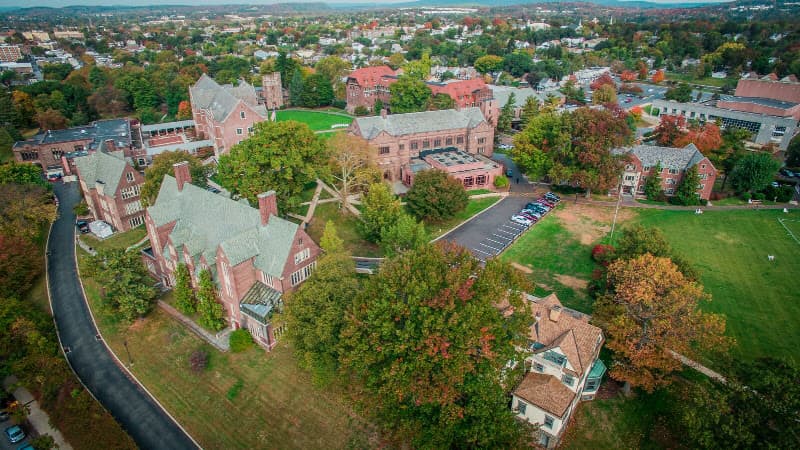
The campus is arranged around a central quadrangle and a large athletic green, with academic buildings, dormitories, dining facilities, and a chapel in close proximity. Architectural styles range from nineteenth century masonry structures to later additions built as the enrollment grew. Facilities that support the program generally include science laboratories, a library and archive, performing arts and visual arts spaces, a field house, an indoor ice rink, multiple gymnasiums, a natatorium, tennis courts, and a series of playing fields used for interscholastic competition.
Dining is a notable part of daily life. The school has long maintained a tradition of seated, family-style meals at which students, faculty, and staff share tables, a practice intended to reinforce the residential community that dates to the founding household model.
Athletics and Activities
The Hill fields teams in a wide range of interscholastic sports across three seasons and competes as a member of the Mid-Atlantic Prep League, an association of boarding schools in Pennsylvania, New Jersey, and Delaware. The annual football and fall sports competition against The Lawrenceville School is among the older continuous rivalries in American secondary school athletics and remains a centerpiece of the fall calendar, drawing alumni back to campus.
Beyond athletics, students participate in music ensembles, theater productions, student publications, debate, robotics, service organizations, affinity and cultural groups, and a variety of clubs organized around academic and recreational interests. Because most students live on campus, evening and weekend programming forms a significant part of the school's offerings.
Community and Inclusion
The school is listed as LGBTQ+ friendly and is identified as a transgender safe space, and gender-neutral restroom facilities are available on the grounds. These designations reflect institutional attention to student support structures that extend beyond the classroom, an important consideration for families evaluating residential schools where students spend the full academic year in the care of the community.
Visiting and Practical Information
Accessibility features at the school include a wheelchair accessible entrance, wheelchair accessible restrooms, wheelchair accessible seating, and a wheelchair accessible parking lot. Parking is available on site at no charge, and free street parking can also be found in the surrounding residential blocks, which is useful during athletic contests, arts performances, admissions events, and reunion weekends when visitor traffic increases.
Prospective families typically arrange campus visits, interviews, and tours through the admissions office in advance of application deadlines, and the school participates in the standard financial aid process used by independent boarding schools, awarding need-based assistance to a portion of its enrollment. Pottstown is reachable by car from the Route 422 corridor and the Pennsylvania Turnpike, with Philadelphia International Airport serving as the nearest major commercial airport for boarding students traveling from out of state or abroad.
Because the campus is an active residential school, visitors are generally asked to check in at the appropriate office on arrival, and access to certain buildings may be limited during the academic day. Calling ahead at +1 610-326-1000 is the most reliable way to confirm event times, tour availability, and seasonal schedule changes.