How the news gets written here
A reader asked me this week how the news gets written. Here's how.
The problem
Berks County has 92 local governments. There's the county, 72 municipalities and 19 school boards. They're meeting all the time. Every meeting has an agenda, and later it has minutes.
Most of them post those on their websites. Some post the night before the meeting. Some post the day after. Minutes can take a month.
Almost nobody reads them. It's too much work to find them and keep track of them.
Why I did this
The decisions that shape life here get made in rooms most of us never have time to sit in. They decide your taxes, your roads, your property and your schools. Most of those meetings never make the news.
I live here. I pay the same tax bills and drive the same roads. This isn't a chain or an out-of-town company. I figured somebody who lives in Berks County should make those decisions easier to follow.
Everyone deserves to know what's going on in their own municipality. Everyone should have a voice. Everyone should be able to vote for the people who'll get things done.
So I decided to cover all of it, using technology and AI.
How it works
It's AI. It's the same kind of AI as the chat assistants you've probably tried. The difference is that I gave it a job, a set of written rules and a computer to work on.
The AI works as agents. An agent is one copy of the AI with one job and its own instructions. Here's what they do every morning, in order.
1. A computer starts the run at 6 a.m.
One agent starts up. I call it the editor. It runs the whole morning.
2. The editor reads its files
It has three.
- The list. All 92 governments are on it. Each one has its agenda page, its minutes page, its meeting night and its check day. The list also holds each website's quirks. Some sites block robots. Some hide the agenda inside a meeting portal. Some name every file the same way.
- The notes. These cover each government: who sits on the board, what's been argued over and what's still open.
- The log. Every morning's work is written down. There are more than 130 of them so far, going back to July 7.
3. It picks who to check
- The county government gets checked every day.
- Each municipality and school board has a check day once a week.
- A board with a meeting in the next two days gets checked today, to catch the agenda.
- A board that met and hasn't posted minutes gets checked again, until it does.
- The legal notices get read too. A hearing or a new ordinance often shows up there first.
- Five other local news outlets get read for leads. If one of them had a story first, we say so and link to it. Then we go to the documents ourselves.
4. It starts the checkers
Checkers are more agents. Each one gets a batch of websites. For each site it does the same things.
- It opens the agenda page and finds anything new.
- It downloads the files and makes sure each one is a document, not an error page.
- It reads the whole thing. One ordinance on Tuesday ran 40 pages.
- It saves every attachment. Governments sometimes swap a file after it's posted, and this is how we notice.
- It reports back what's new, what's up for a vote, what it costs and when the meeting is.
A checker can't just say "nothing new." It has to name the newest document it found and give the date.
5. The editor picks the stories
It asks one question. Does this matter to the people who live there? Taxes, budgets, property assessments, public safety, roads, elections and contracts make it. Proclamations and ceremonies don't.
There's no limit on stories. If six things matter that day, six get written. A meeting gets a preview before it happens and a recap after. A story that runs for months gets one page that we keep updating, like the data centers.
6. A writer writes each story
A writer is another agent, and it gets one story. It gets the documents. It gets what we've already published about that board, so the new story connects to the old ones. Its rules are simple.
- Write from the documents and nothing else.
- Write so an eighth grader can follow it.
- Start with what changed, who it affects and what it costs. Then say what happens next and how to comment.
- Link the document behind every fact.
- Name the town in the headline. If there's a dollar figure, put it there too.
- Mark any number it couldn't read for itself.
7. A fact-checker tries to break it
This is a new agent. It has never seen the story, and it has no reason to like it. It gets the draft and the documents.
- It opens every document again.
- It checks every number, name, date, title, address, vote and quote.
- It marks each claim as supported, unsupported, contradicted or impossible to check.
- It makes sure each document is the newest version. Agendas get amended all the time.
- It has to answer one last question. What is the strongest way this story is wrong or incomplete?
If two official documents disagree, the story says so. It doesn't pick one.
8. The story gets fixed and checked again
The problems go back to the writer. The changed sentences go back to the same fact-checker. A story gets two rounds of this.
To run, a story needs zero unsupported claims and zero contradicted ones. A claim that can't be checked gets pinned to its source or cut. A story that still isn't clean after two rounds doesn't run. I'd rather publish nothing than publish something wrong.
9. The editor publishes
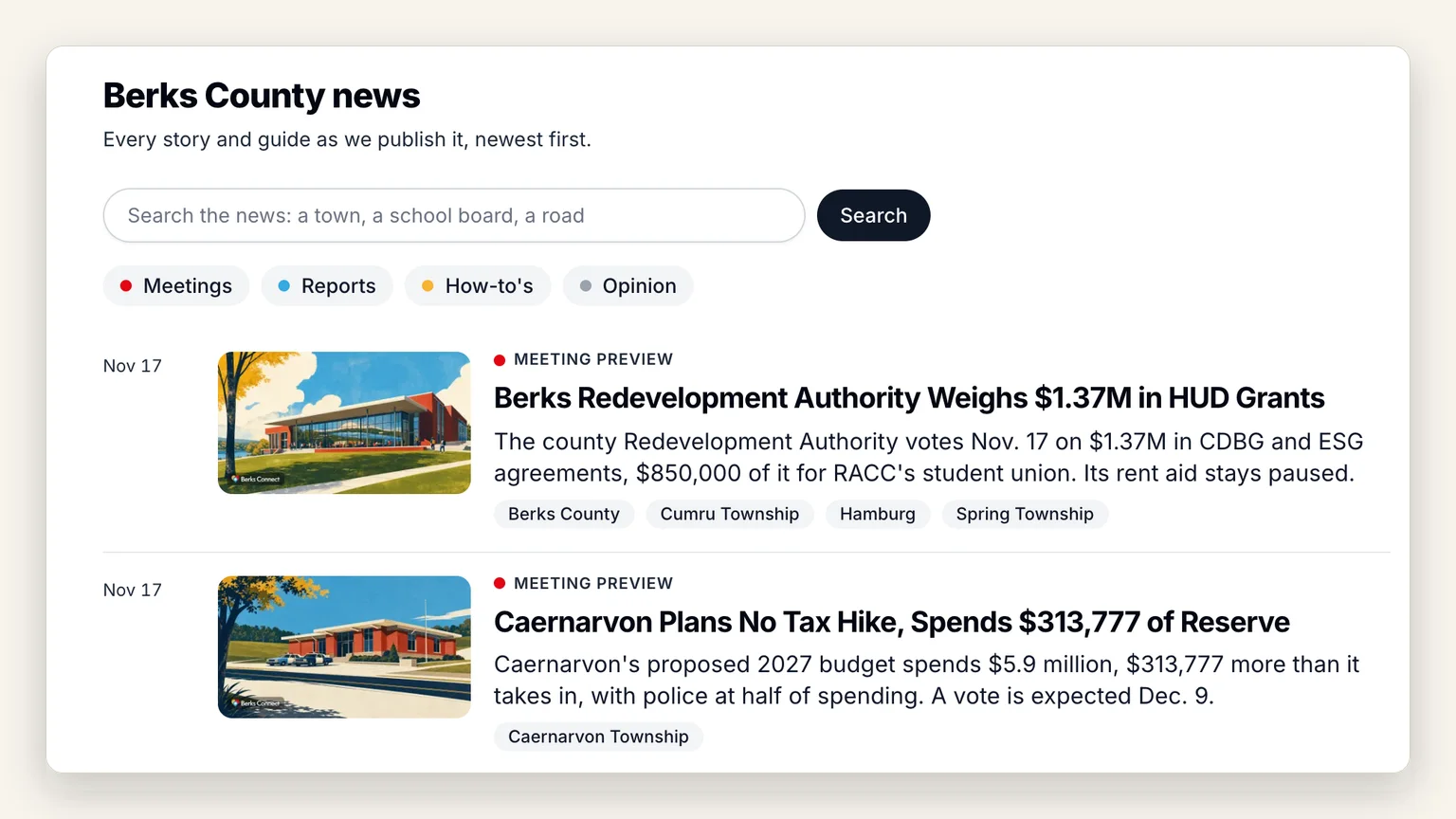
It reads the story one last time for plain writing. It tags the government, so the story shows up on that town's page. A school district story shows up on every town the district serves. Then it puts the story on the news page and checks that the page loaded. A separate AI draws the picture.
10. It writes down what it learned
New facts about a government go in the notes. Mistakes in its own process go in the rules. In the last eight days it added 25 lessons. Here are two of them.
- Governments print the wrong year in their own agendas. Quote the agenda as printed, then say what the date has to mean.
- A notice can be taken back the next day while the file stays online. Read the feed again before reporting a new notice.
How it writes
It writes like a newspaper reporter. It states the facts and gets out of the way. Those are my rules, and I was picky about them.
- Plain words. An eighth grader should be able to follow it.
- The first thing you read is what it means for you.
- The headline names the town and the stake. If there's a dollar figure, it goes in the headline.
- No filler. Words like "actually" and "basically" get cut.
- No opinions in a news story. An opinion piece is labeled as one.
I also didn't want it dry. A story about a sewer rate can still have a pulse. So the rules ask for short sentences and a headline that makes you want to read. A headline can sell the story. It can't promise more than the story delivers.
Is that my style? Some of it. I like short sentences and plain talk, and that's in there. It may not be how a journalism school would teach it. It's how I decided to do it.
One real morning
On a quiet day the editor does all of this alone. On a busy day it starts helpers. This Tuesday was busy.
- Nine governments posted agendas overnight.
- 22 agents worked: one editor, five checkers, eight writers and eight fact-checkers.
- They made about 110 checks.
- The fact-checkers tested 728 claims.
- Seven stories ran, and eleven older pages got updated. The first stories were up at 7:17.
One of them was Amity Township's budget preview. The fact-checker tested 92 claims in the draft. Eighty-four were supported. Five weren't. Two were contradicted. One couldn't be checked. The biggest miss was the headline. It said the budget raises a tax. The documents only showed that as a proposal from October. The headline got changed before anyone saw it.
What I do
I don't read each story before it goes up. The fact-check is the gate. I do read them after they run.
I wrote the rules. I change them when something goes wrong. I'm responsible for everything that runs.
The AI can change how it works. It can't change the rules about facts. Only I can.
Where it falls short
It can't sit in the room. It only knows what's in the record. Two small boroughs post nothing online, so there's nothing for it to read there.
It gets things wrong sometimes. When it does, I correct the story and say so on the page.
It also writes too dense. Left alone, it packs a paragraph with numbers until you can't get through it. I fight with that all the time.
Here's why it's a fight. The AI behind this keeps changing. Every time a new version comes out, the writing style changes with it. So I'm always catching up.
Every story has to pass two questions. Does it make sense to a person? Could an eighth grader understand it? The answer has to be yes to both. That's the hardest part of all of this.
So there's constant upkeep, even though it teaches itself. I still read the stories to make sure it isn't going off the rails.
If you were at the meeting and a story missed what mattered, tell me.
Since July it has published more than 330 stories and guides. Every one links the documents it came from. You never have to take my word for it. The About page has the full standards.