Breaker Keeps Tripping in Berks County? What to Check First
Why a circuit breaker keeps tripping, the checks you can safely do yourself, the signs that mean stop and call an electrician, and what to tell them when you do.
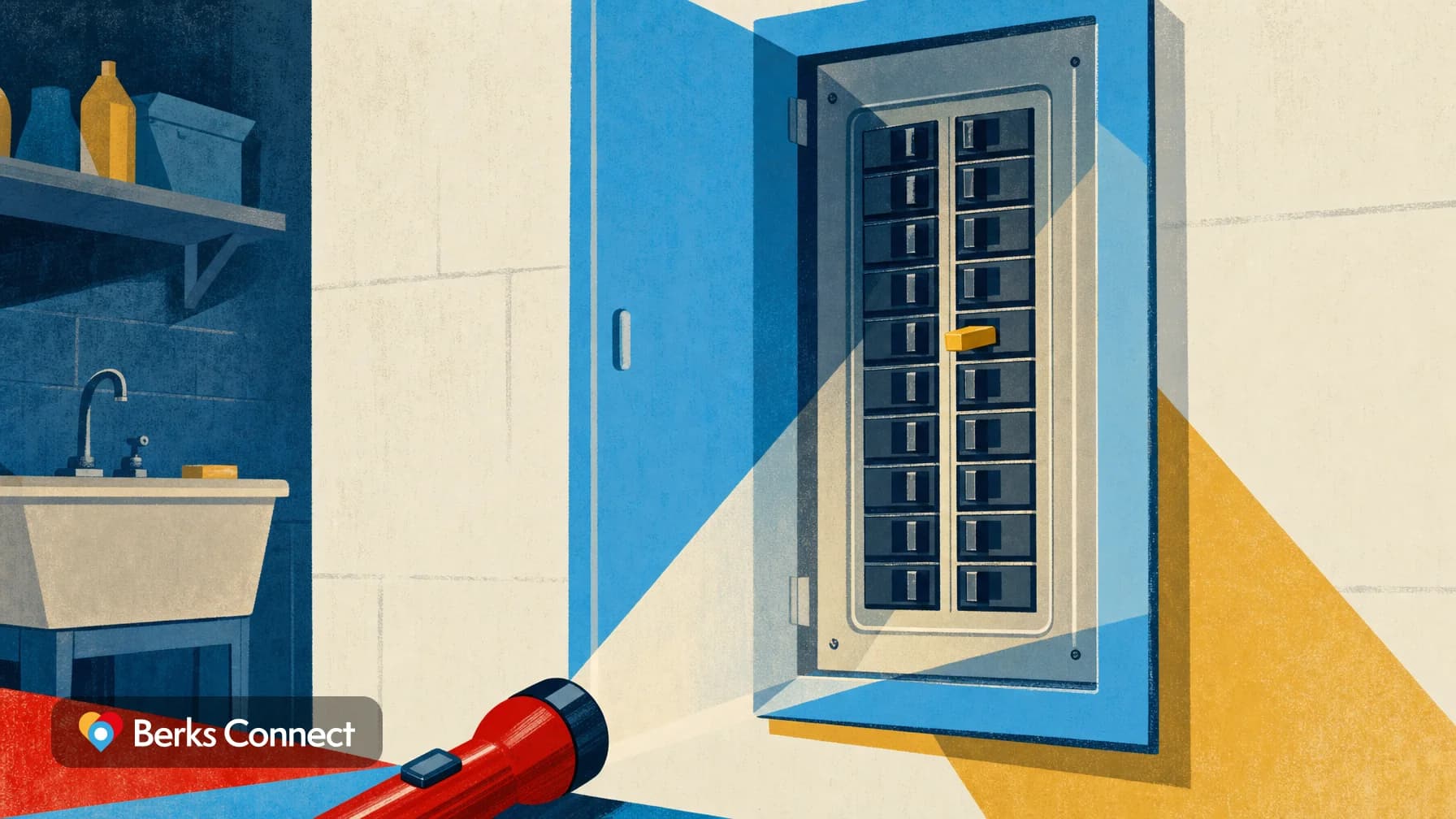
If your breaker keeps tripping, the breaker is almost certainly doing its job. A breaker is a switch that shuts a circuit off when too much current runs through it. One that keeps shutting off is reacting to something on that circuit. A worn-out breaker is the last thing an electrician checks, not the first.
You can find out a lot about what's on that circuit without taking the panel cover off or touching a wire. Unplug everything on the circuit, reset the breaker the right way, and plug things back in one at a time. If it trips with nothing plugged in, or you smell burning, or you see a scorched outlet, you're done checking and it's time to call an electrician.
If it comes to calling an electrician, I'd start with the Berks County electricians page.
Why does a breaker keep tripping?
Three things can trip a breaker: too much current, current leaking out of the circuit, and sparking inside the wiring. Different breakers catch different ones, and some catch more than one. You can tell them apart at the panel. A standard breaker is a plain switch, and a GFCI or AFCI breaker has a TEST button on its face.
A standard breaker trips on too much current. That's either an overloaded circuit or a short circuit. A short circuit usually happens when a hot wire touches a neutral wire, and the current takes a shortcut it was never meant to take.
A GFCI is a ground fault circuit interrupter. A ground fault is when current leaks out of the circuit, for example through water or through a person. The GFCI compares what goes out with what comes back, and if even a tiny amount goes missing, it shuts off. It's there to protect you from shock. If your GFCI is a breaker in the panel, it also trips the ordinary way, on too much current, so a GFCI trip isn't always a leak.
An AFCI is an arc fault circuit interrupter. An arc fault is sparking inside wiring or a cord, the kind you'd get from old, frayed, or nail-punctured wire. The AFCI can pick up the pattern that sparking makes, and it shuts off when it sees it. A standard breaker generally won't catch it. The AFCI is there to protect you from fire.
A GFCI isn't always a breaker in the panel. It can also be the outlet with TEST and RESET buttons in a bathroom, kitchen, garage or outdoors, and that kind resets at its own button. If something's dead and no breaker looks tripped, check those outlets too.
So what causes the trips? Start with too many things on one circuit. Two heat-producing appliances can do it, like a space heater and a toaster. The rule of thumb is one heat-producing appliance per outlet. A power strip adds outlets, not capacity.
A short circuit does it too. So does a ground fault, and that one often comes from a damp or damaged appliance. An arc fault can be an actual spark inside the wall. Or the AFCI can trip with no spark at all, which electricians call a nuisance trip, and that just means nobody has found the cause yet. Sometimes the cause is a device the breaker mistakes for an arc, and a vacuum cleaner's motor is the usual example. Sometimes it's a loose or damaged wire, and that's the one that matters. Last, after everything else is ruled out, the breaker itself can be failing.
Notice when it trips, too. If the breaker trips the instant something switches on, it's reacting to a surge from a short or a motor starting up. If it trips after the thing has run a while, it's tripping on heat, which usually means the circuit is pulling more than it should.
What can you safely check before you call?
You can do all of this with the panel cover on and your phone in one hand. Don't take the cover off, and don't touch any wiring. Do it with dry hands, standing on a dry floor. If there's water anywhere near the panel, leave the panel alone and call.
- Take a photo of the breaker face before you touch it. Newer GFCI and AFCI breakers have a small light on the face, and that light tells the electrician what tripped it.
- Find out what the breaker feeds. There's a label next to each breaker in the panel, and it should name the room or the circuit. If the label is blank or wrong, walk the house and note what went dead. Everything that's out is on that circuit.
- With the breaker off, look around that circuit. You're looking for blackened plugs or outlets and for cords that are damaged or pinched. If you find any of that, skip straight to the stop list below and call.
- Unplug everything on that circuit, including the things you're sure are fine. If the circuit is mostly wired-in things like ceiling lights and a bathroom fan, turn those off at their switches instead.
- Reset the breaker. Push the handle all the way to OFF first, then all the way to ON. On most panels a tripped breaker sits partway between ON and OFF, though some fall all the way to OFF. Either way, push it fully off before you push it on. Take a second photo as it comes back on, because on some breakers the light only shows for a few seconds right then.
- If it holds, plug things back in one at a time, or switch them back on one at a time. Switch each one on before you move to the next. The one that trips it is your answer.
If it trips again with nothing plugged in or switched on, stop there and call. If it trips when one particular item goes in, stop there too, and leave that item unplugged. If it holds, and everything is back on and running, you most likely had too much on at once. Spread those things across other outlets and keep an eye on it. If it starts tripping again, that's the case for a call.
Is it the appliance or the circuit?
You might be wondering whether it's the toaster or the kitchen wiring. If one appliance trips a breaker no matter which room you plug it into, the appliance is almost certainly the problem. If one outlet or one room trips the same breaker no matter what you plug in, the circuit is probably overloaded, and that's a call to an electrician.
The fix for an overloaded circuit is a new circuit from an electrician. It's never a bigger breaker. Putting a 30-amp breaker or fuse on a 20-amp circuit is a fire hazard.
When should you stop and call an electrician?
Any one of these means stop what you're doing and call now. If it's late, leave that breaker off, keep everything on the circuit unplugged, and call first thing in the morning.
- A burning or rubbery smell at the panel or at an outlet.
- Sparks from an outlet or from the panel.
- An outlet or switch plate that's hot, not just slightly warm.
- Discolored or scorched outlets or plugs.
- Buzzing, sizzling, or crackling from an outlet or the panel.
- Lights that flicker or dim, especially across the house and not just in one room.
- A tingle or a mild shock from an appliance or a switch.
- A breaker that won't reset, or that trips again immediately with everything unplugged.
If you rent, call the landlord as well as the electrician.
What about a breaker that just feels warm? On its own, that isn't a fault. A breaker can run warm in ordinary use, and you can't tell much by touch. If a warm breaker is also tripping, or it's discolored or smells, call now.
What if it trips randomly, or it's the air conditioner?
A breaker that trips "randomly" usually isn't random. Usually it's a GFCI or an AFCI reacting to some device in the house, or a wiring problem that comes and goes. The devices known to set these breakers off are dimmers, ceiling fan speed controls, LED light fixtures, and the plug-in boxes that send internet through your power lines. Notice whether one of those was running. Keep a short note on your phone of when it trips and what was running. The electrician will ask.
Air conditioners get their own rule: stop after one reset, whether it trips at startup or twenty minutes in. Repeatedly resetting a breaker that feeds a compressor can damage the compressor.
Can you tell if the breaker itself is bad? There's one check you can do from the outside, and it only works on GFCI and AFCI breakers, the ones with the TEST button. Reset the breaker, then press TEST. A working breaker trips when you press it. If the handle doesn't move, something's wrong with the breaker or the circuit, and that's a call. Skip this check on the air conditioner's breaker, because pressing TEST trips it and that means another reset.
That light can also show the electrician that the breaker itself has failed, which is another reason for the photos. For a standard breaker, there's no test from the outside. An electrician decides it's bad after checking the connections inside the panel.
What happens when you call?
The electrician will open the panel and check the connections inside. If the fix turns out to be a new breaker, don't try that swap yourself either. Whether that needs a permit depends on your town. Pennsylvania doesn't require a permit for an ordinary repair, but the state never says whether a breaker swap is one, and every borough and township in Berks County enforces the rules on its own. The electrician will know what yours wants. If the conversation turns to the panel being old or full, I've written up what a panel upgrade costs in Berks County.
What a diagnostic visit costs is in the post on what electricians charge per hour in Berks County. If you've never hired a trade in the county before, the guide to hiring home services in Berks County covers how to pick one and what to ask.
So here's what I'd do tonight. Photograph the breaker face, unplug the circuit, and reset it the right way. Plug things back in one at a time and write down what happens. If it holds and you found the guilty appliance, you're done. If it trips on nothing, or you hit anything on the stop list, make the call. I'd start with the Berks County electricians page.
Sources
- ESFI, "Understanding Your Home Electrical System" and ESFI, "Fuse and Breaker Breakdown": what a breaker does, what a standard breaker, a GFCI and an AFCI each trip on, the reset instructions, the oversized-fuse hazard, and that frequent trips need an electrician.
- CPSC, "Guide to Home Wiring Hazards" (Publication 518): check which breaker tripped and which appliances lost power before resetting.
- CPSC, "What is a GFCI?" (Publication 099) and CPSC, "Preventing Home Fires: Arc Fault Circuit Interrupters" (Publication 5133): how small a leak trips a GFCI, and AFCIs for fire versus GFCIs for shock.
- Siemens, "AFCI-GFCI Circuit Breaker Diagnostic Guide": the homeowner procedure (note the circuit, check for blackened plugs and damaged cords, unplug everything, reset, add loads back one at a time, call if it trips), nuisance trips, and the trip-indicator lights.
- CPSC, "Home Electrical Safety Checklist" (Publication 513): not repeatedly resetting a breaker that feeds an air conditioner compressor.
- Schneider Electric, "How do you determine why a thermal-magnetic breaker nuisance trips?" and Schneider Electric, "What is the handle position of a QO branch breaker when ON, OFF and tripped?": trips at startup versus after a while, the breaker as the diagnosis of last resort, the middle handle position, and pushing the handle fully off before on.
- Schneider Electric, Data Bulletin 0600DB1603, "Circuit Breaker Operating Temperatures" (March 2025): a warm breaker is normally within operating limits and touch is not a reliable gauge.
- Schneider Electric, "Reasons You Are Experiencing Frequent MCB Trips": overload, short circuit, ground fault and a faulty breaker as causes.
- UL Solutions, "8 Signs You May Have a Problem with Your Electrical Wiring" and UL Solutions, "Guide to Power Strips and Surge Protectors": the appliance-versus-circuit test, the odor, sparking, hot-outlet and buzzing warnings, and heat-producing appliances on power strips.
- ESFI, "Don't Overload Your Home" and ESFI, "Home Wiring Safety Tips": one heat-producing appliance per outlet and the warning signs of wiring hazards.
- Leviton, "Understanding AFCI Challenges and Addressing Nuisance Tripping" and Leviton, "Dual Function AFCI/GFCI Receptacle FAQs": the new-vacuum nuisance trip, arc-fault causes, and panel versus outlet resets.
- ESFI, "How to Test an AFCI" and ESFI, "How to Use GFCIs": the TEST button check on AFCI and GFCI devices; Schneider Electric, "The test button on a QO-GFI or HOM-GFI breaker will not trip the breaker; is the breaker bad?" for the breaker that fails its own test because of a leak on the circuit.
- NFPA, "Electrical Safety" tip sheet: the call-an-electrician list, including "or your landlord".
- 34 Pa. Code § 403.62, Permit requirements and exemptions (residential) and 34 Pa. Code § 403.1, Scope: ordinary repairs and the municipal-ordinance exception.