Knob and Tube Wiring in Berks County: Safety and Cost
Is knob and tube wiring safe, will an insurer cover it, and what a rewire costs in Berks County, with the state rules on cancellation and the FAIR Plan backstop.
This is for the Berks County homeowner or buyer who just heard the words knob and tube wiring from an inspector, an agent, or an electrician.
The wiring is legal to keep. The fires come more often from changes made to the wiring over the years, and from insulation packed over it, than from the old wiring on its own.
Whether an insurer will cover the house is that carrier's own call. A whole-house rewire runs about $3 to $5 a square foot. So make two calls this week: a Berks County electrician first, for an assessment and a quote, so you can tell your insurance agent which circuits are still on the old wiring and what the plan is; then the agent, before the policy renews or the sale closes.
Is knob and tube wiring safe?
Left alone, the old wiring is less often the problem than what's been done to it since. Changes people made to a house's wiring over the years are the single most common factor in house-wiring fires, and insulation packed over old wiring is the hazard you can check for yourself. So the question isn't whether the house has it; it's what's been done to it since.
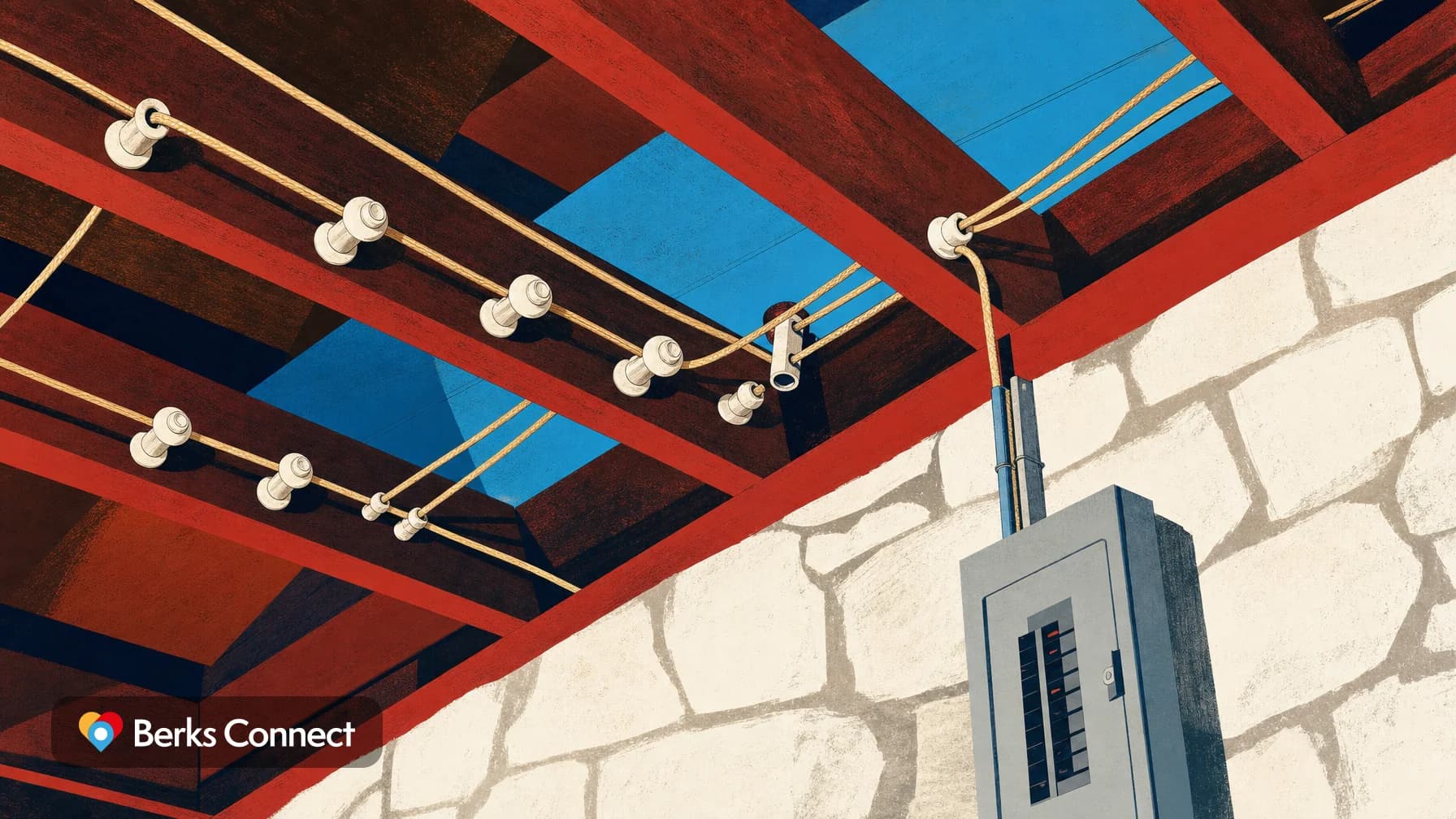
Knob-and-tube is the oldest kind of house wiring still in service: single wires, each one run on its own through ceramic knobs and tubes, with open air around the wire so it can shed heat. It was the common way to wire a house before about 1950, and by the late 1960s it had dropped out of new construction.
It's still legal to have. Nobody wires a new house with it anymore, but what's already in the walls can stay in service. Nothing in the code makes you rip it out.
So where do the fires come from? Most often from changes made later. A circuit (one run of wire from the fuse box out to a set of lights and outlets) gets extended with newer cable. The old fuse lets through more current than the new cable can safely carry, so the fuse never blows to protect it. Or too much gets loaded onto one circuit, or somebody made a sloppy alteration. And the insulation on old wiring of any kind can go brittle with age, so it's likely to crack when someone swaps a light fixture or an outlet on that circuit.
The hazard you can check for yourself is insulation, and I mean the stuff in your attic, not the coating on the wire. This wiring was designed to run in open air, which is how it sheds its heat. Blow insulation into an attic, or stuff batts into a wall, over live old wiring, and the heat the wire was built to shed has nowhere to go. An attic that's been insulated over live old wiring is the first thing to have checked.
How do you tell if your house has it?
Look up. The basement ceiling and the attic are where you're likeliest to see the wiring exposed, and the old kind shows up as single wires, not a flat cable, running through ceramic knobs and tubes.
A home inspector or an electrician can confirm it. What the electrician adds is which circuits are still on it, because in a lot of old houses some circuits have been replaced and some haven't. A rewired kitchen under an untouched second floor is normal, and the quote depends on that count.
If the inspector said aluminum instead, that's a different problem from a later era, with different fixes.
Which Berks County houses are old enough to have it?
About a third of the county's houses were built before 1950, and in the city of Reading it's two thirds.
Here are the places with at least 1,000 homes where the largest share of the housing dates from before 1940. It's a count of houses old enough to have the old wiring, not of houses that do.
| Place | Homes built before 1940 | Share of the place's homes |
|---|---|---|
| Reading | about 20,500 | 57 percent |
| West Reading | about 1,000 | 59 percent |
| Shillington | about 1,100 | 46 percent |
| Boyertown | about 970 | 47 percent |
| Mount Penn | about 630 | 47 percent |
| Berks County as a whole | about 47,200 | 28 percent |
Plenty of pre-1940 houses were rewired long ago, and every township in the county has some houses that old, not only the towns on the list.
What does it cost to replace it?
About $3 to $5 per square foot for a whole-house rewire, as of 2026. That's roughly $3,000 to $5,000 for a 1,000-square-foot house, $6,000 to $10,000 for 2,000 square feet, and $9,000 to $15,000 for 3,000. For your own house, multiply the square footage by $3 to $5. Expect a firm number only after an electrician has walked the house. How electricians here price a rewire is in the post on what electricians charge in Berks County.
If the house still has a fuse box, replacing it with a breaker panel is a separate job with its own price, covered in the post on electrical panel upgrade cost in Berks County.
Will insurance cover a house with it?
Whether a carrier will write a house with the old wiring is that carrier's own decision, so the answer comes from your agent. Ask before the policy renews or before you close, and if you don't have an agent yet, the county's insurance agents and brokers page is where to find one.
What the state does regulate is how a carrier can drop you. Once a homeowners policy on the house you live in has been in force for 60 days, the carrier can only cancel it, or refuse to renew it, for a short list of reasons; a substantial change or increase in the hazard is one of them, and the Insurance Commissioner can approve others. If a notice ever names the wiring as the reason, that's the moment to use the ten-day review described next.
Any notice of cancellation or refusal to renew has to give you at least 30 days before it takes effect. It has to state the specific reason clearly and completely, and if the reason is an increased hazard, it has to say which one. And it has to tell you that you can ask the Pennsylvania Insurance Department to review the decision within ten days of receiving the notice. Ten days goes fast, so read any notice the day it arrives.
What a policy pays out after a fire is a separate question. This one is about getting and keeping the policy.
What if you can't get a regular policy?
There's a backstop. The Pennsylvania FAIR Plan (formally the Insurance Placement Facility of Pennsylvania, running since 1968) provides basic property insurance on one-to-four family homes for owners the regular market turned down: fire and lightning on the basic form, with windstorm, hail, smoke and vandalism available as added coverage.
You can apply through an insurance agent or directly. It's property coverage, not a full homeowners policy, and it comes after your agent has tried the regular market, not before. If you get stuck, the Pennsylvania Insurance Department's consumer help line is 1-877-881-6388.
What to ask the electrician for.
Ask for a written scope that answers three things.
- Which circuits are being replaced. Some are usually done already, and the scope should name the ones that aren't.
- Whether the old wiring is being disconnected and left in place, or removed.
- That the permit is included.
A rewire is permitted work. Pennsylvania's construction code requires a permit to alter, repair or replace an electrical system in a house, and the job ends with an inspection. Kutztown's permit sheet, for one, lists "upgrading knob & tube wiring" by name. Each town sets its own fee, and the electrician pulls the permit, not you. Which electrical jobs need a permit in the first place is in the post on whether you need an electrician for a job in Pennsylvania.
There are two checks on the contractor before you sign. Anyone doing $5,000 or more of home improvement work a year has to be registered with the Pennsylvania Attorney General, and that registration number goes on the contract. In Kutztown, for one, the electrician also needs a borough license to pull the permit, and the licensing post lists the towns that license electricians. The post on what a licensed electrician means in Pennsylvania walks through those checks, and how to vet any contractor is in the guide to hiring home services in Berks County; this post covers only what's specific to a rewire. When you're ready for quotes, start with the county's electricians page.
So, tonight: go look at the basement ceiling. Tomorrow, book an electrician's assessment, ask for a written scope and a quote, and call your agent before the policy renews or the sale closes. The house has had this wiring for a long time, and now you know what to do about it.
Frequently asked questions.
Do I have to take the old wiring out?
No. Nothing in the electrical code makes a homeowner remove existing knob-and-tube.
Can I add attic insulation and leave the wiring alone?
Have the wiring checked first. The old wiring sheds its heat into open air, and insulation blown or stuffed over live wiring holds that heat against it. An attic that's already been insulated over live old wiring is the first thing to have an electrician look at.
Can my insurer drop me over the old wiring?
Whether a carrier writes or keeps a house is that carrier's own decision, so ask your agent. What the state sets is the process. After a policy on the house you live in has been in force 60 days, the carrier can only cancel it, or refuse to renew it, for a short list of reasons. Any notice has to give you at least 30 days and state the specific reason, including which hazard if that's the reason. If a notice ever names the wiring, ask the Pennsylvania Insurance Department to review it within ten days of receiving the notice.
Sources
- U.S. Census Bureau, American Community Survey 2020 to 2024 five-year estimates, table B25034 "Year Structure Built," Berks County and its municipalities: the county, Reading and borough counts and shares of homes built before 1940 and before 1950 (pulled September 11, 2026).
- U.S. Consumer Product Safety Commission, Smith and McCoskrie, "What Causes Wiring Fires in Residences?", Fire Journal (January/February 1990): knob-and-tube common in dwellings over 40 years old and absent from those 20 years old or less; 25-amp fuses left on circuits extended with 15-amp cable; conductor ratings set in free air and the stress of later insulation; improper alterations as the most frequent contributing factor.
- Fire Protection Research Foundation, "Evaluation of Electrical Conductors in Thermal Insulation" (August 2023): knob-and-tube needs the surrounding air to shed heat; embrittled old insulation cracks when fixtures or receptacles are replaced.
- NFPA 70, National Electrical Code, Article 394, Concealed Knob-and-Tube Wiring (free access with registration), summarized at Pocket Guide to the National Electrical Code, Article 394: the code still recognizes knob-and-tube and permits it only to extend an existing installation.
- HomeAdvisor, "How Much Does It Cost to Rewire a House in 2026?" (updated June 17, 2026): the $3 to $5 per square foot rewire figure and the 1,000, 2,000 and 3,000 square foot ranges.
- 34 Pa. Code § 403.62, Permit requirements and exemptions (residential): a permit is required to alter, repair or replace an electrical system in a house.
- Kutztown Borough, Electrical Permits information sheet: "Upgrading knob & tube wiring" listed as work requiring a permit; borough-licensed electricians pull the permit.
- Pennsylvania Home Improvement Consumer Protection Act, 73 P.S. §§ 517.2, 517.6 and 517.7: the $5,000-a-year registration threshold and the registration number required on every contract.
- 40 P.S. § 1171.5(a)(9), Unfair Insurance Practices Act: a homeowners policy in force 60 days or more can be cancelled or nonrenewed only for the listed reasons, including a substantial change or increase in hazard.
- 31 Pa. Code § 59.6, Notice of cancellation or refusal to renew; requirements and § 59.7, Appeal procedure: at least 30 days' notice, the specific reason stated clearly and completely, and the right to request Insurance Department review within ten days of receipt.
- Pennsylvania FAIR Plan (Insurance Placement Facility of Pennsylvania), with its coverages and how to apply pages: basic property insurance since 1968 for owners unable to get it in the voluntary market; fire and lightning on the basic form with windstorm, hail, smoke and vandalism available; applications through a producer or directly.
- Pennsylvania Insurance Department: the consumer help line, 1-877-881-6388.