Water Heater Replacement Cost in Berks County
National cost ranges for replacing a water heater, the tank, tankless and heat pump decision for our housing stock and our water, and what eight Berks County municipalities publish about permits.
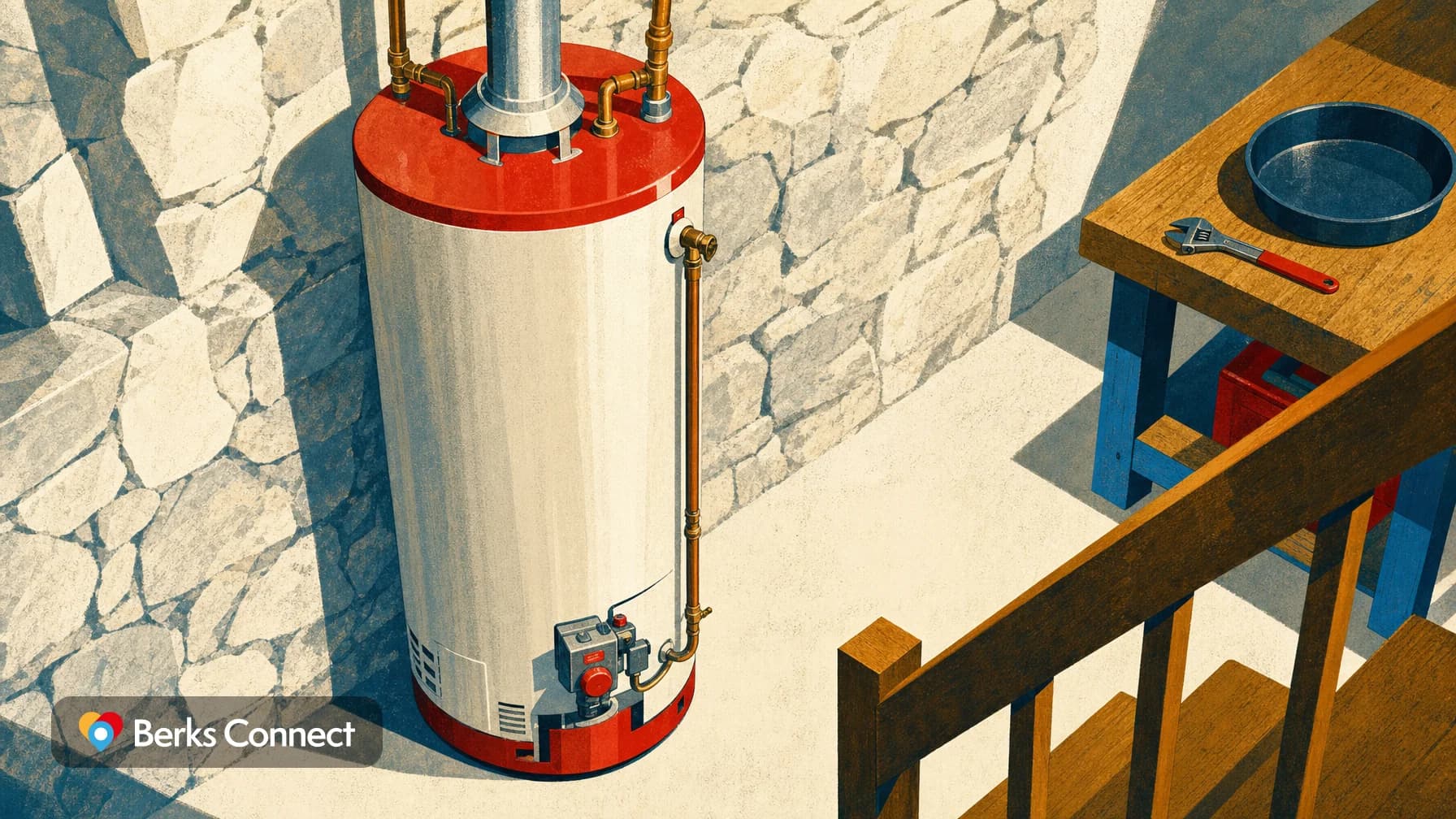
Replacing a water heater runs $1,600 to $5,400 installed, with $1,950 given as the average, per a national cost guide updated June 2026. A second national guide, updated January 2026, splits it by type: $600 to $2,500 for a standard tank, $1,000 to $4,000 for tankless, and $1,200 to $4,600 for a heat pump unit. Every figure in that paragraph is national, not a Berks County quote, and the spread between the low end and the high end is where every decision in this post lives.
Nobody shops for a water heater. They shop for one at 6 a.m. in a wet basement with an hour to decide, which is how people end up with whatever was on the truck that morning.
Twenty minutes now buys you the type, the temperature setting and the plumber, all picked in daylight. Plumbing listings across Berks County live on our plumbers page for Berks County.
What a water heater replacement costs nationally.
Two national cost guides publish different numbers for the same job. Read both, because the gap between them tells you how wide the range runs before anyone has looked at your basement.
National installed cost by water heater type, per a national cost guide updated January 2026:
| Water heater type | National installed range |
|---|---|
| Tank-style | $600 to $2,500 |
| Tankless | $1,000 to $4,000 |
| Indirect | $1,200 to $4,500 |
| Heat pump / hybrid | $1,200 to $4,600 |
National installed cost by tank size, from two national guides:
| Tank size | National guide, updated January 2026 | National guide, updated June 2026 |
|---|---|---|
| 30 gallon | $550 to $2,100 | not published |
| 40 gallon | $550 to $2,300 | $600 to $1,200 |
| 50 gallon | $700 to $2,500 | $700 to $1,800 |
| 75 gallon | $1,100 to $3,400 | $900 to $2,300 |
| 80 gallon | $1,200 to $3,600 | $1,000 to $3,000 |
The unit is the part everyone quotes. The line items below are the part that moves a quote by thousands, and they are also national figures.
| Line item on the quote | National range | Guide's update date |
|---|---|---|
| Plumber labor, hourly | $45 to $200 | January 2026 |
| Plumber labor, hourly | $40 to $200 | June 2026 |
| Old unit disconnection and disposal | $75 to $500 | January 2026 |
| Old unit disconnection and disposal | $100 to $300 | June 2026 |
| Expansion tank | $40 to $150 | June 2026 |
| Permits and inspections | $25 to $1,500 | January 2026 |
| Permits and inspections | $50 to $200 | June 2026 |
| Venting, gas unit | $500 to $1,100 | January 2026 |
| Power vent plus its electrical connection | $300 to $1,000 | January 2026 |
| Stainless venting through a wall or roof, tankless | $400 to $800 | June 2026 |
| Gas line conversion for tankless | $350 to $750 | June 2026 |
| Dedicated 240-volt outlet | $140 to $300 | January 2026 |
| Dedicated circuit breaker | $400 to $2,000 | January 2026 |
| New circuit for a tankless unit | $200 to $600 | June 2026 |
| Full electrical panel upgrade | $1,000 to $2,000 | June 2026 |
One number explains more than any of the others. On a gas job, the January 2026 guide puts labor at around 20 to 25 percent of the total for a tank-style unit, an average of $200 to $650, and "closer to 50 percent of the total, or $800 to $2,000" for tankless.
That is not a small difference in a line item. It means a tank quote and a tankless quote are two different shopping trips, and comparing the sticker price of the boxes tells you almost nothing.
Tank, tankless, or heat pump in a Berks County house.
For a like-for-like swap in an older house, a tank is the cheapest install and the least disruptive. Tankless costs more to put in and asks more of your gas line, your venting and your water. A heat pump unit costs the most up front and cuts the running bill, if your basement gives it the air and the temperature it needs.
The tank, and what it costs to put one in.
A gas tank runs $1,000 to $2,700 installed and an electric tank $800 to $1,500, per national guides updated January 2026. Venting a gas unit adds $500 to $1,100, and a power vent with its electrical connection adds $300 to $1,000.
Tankless, and what it asks of the house.
Tankless installs at $1,000 to $4,000 per the January 2026 guide, and at $1,200 to $3,500 averaging $2,800 per the June 2026 one. A gas tankless unit runs $1,600 to $4,000 installed, per the January 2026 gas page.
Then come the add-ons that a tank job does not have: the gas line conversion, the stainless venting, the new circuit or the panel upgrade, all priced in the table above. Settle your water hardness question before you sign anything for one of these, for reasons in the water section below.
Heat pump, and the Berks basement problem.
A hybrid electric unit installs at $2,000 to $4,000 on the same guide's electric water heater page, against the $1,200 to $4,600 the same publisher gives on its general water heater page. What you buy for that is a lower electric bill, and the agency puts numbers on it.
Per ENERGY STAR, compared with a standard electric water heater:
| Household size | Annual electric bill savings | Payback | Lifetime savings |
|---|---|---|---|
| 2 people | $270 | 5.5 years | $2,050 |
| 3 people | $410 | 3.7 years | $3,830 |
| 4 people | $550 | 2.7 years | $5,610 |
Now the caveat, and in a county of old stone basements and unheated crawl spaces it is the whole ballgame. ENERGY STAR's own page says these units "should be installed in interior spaces that remain between 40 to 90 degrees F year-round" with "1,000 cubic feet of air space around the water heater," that "they generally don't operate as efficiently in colder spaces, and can cool the spaces they are in," and that in colder environments they "may need to go temporarily into a back-up standard electric water heating mode" during colder months, which raises energy use in those months.
Walk your basement with a tape measure before you fall in love with the payback table. Cold room, small room, or a room you already keep warm on purpose: those are three different answers.
One more thing for comparing efficiency numbers on two quotes. Per ENERGY STAR, water heaters are sorted into four bins by daily hot water usage, and "UEF is only compared across water heater models that belong to the same bin," so two UEF figures from different bins are not a comparison at all.
The Berks County layer: old houses and a fuel mix that is not the country's.
Our housing stock is why the national tables only get you so far. Per the Census Bureau's American Community Survey 2024 five-year estimates, 47,206 Berks County housing units, 27.5 percent of the total, were built in 1939 or earlier, and 63.6 percent predate 1980. The median year built here is 1969, against 1965 for Pennsylvania and 1980 nationally.
The fuel picture is its own story. In occupied Berks County housing units, the same survey puts utility gas at 42.3 percent, fuel oil or kerosene at 22.9 percent, electricity at 22.9 percent, bottled or tank propane at 7.0 percent and wood at 2.7 percent. That gas share sits below Pennsylvania's 51.3 percent and the national 46.5 percent, while the oil share runs several times the national rate.
That is a heating fuel table, not a water heater table, and the Census publishes no water-heater fuel figures. It still tells you something true: "just get a gas one" is advice written for a country with more gas mains than this county has.
If gas is on your list, UGI's own Berks County page says natural gas "is available to over 82,000 homes in Berks County, Pennsylvania," and that homes within 150 feet of an existing gas main converting a heating system can connect for little to no charge, with a list of exclusions in the utility's own footnote. That statement is about a heating system conversion, so ask the utility directly what applies to a water heater at your address.
And if you are putting a gas unit into a tight basement or a closet, the combustion air rules are a cost driver nobody mentions. The 2021 fuel gas provisions Pennsylvania adopted require 50 cubic feet of room volume per 1,000 Btu/h of appliance input under the standard method, and where a room cannot supply that, the code sets out how outside air has to be brought in. A sealed closet does not pass on good intentions.
What Berks County water does, and does not do, to a water heater.
There is no single Berks County hardness number, and anyone who hands you one is guessing. Hardness here is set by the rock under your well, and public supply is a separate question again.
Start with the county's own submitted-sample record. The Penn State Agricultural Analytical Services Laboratory's Berks County drinking water summary covers 464 samples from 9/12/2007 to 6/16/2025; hardness was reported on 190 of them, with a median of 61.7 mg/L, a minimum of 0.8 and a maximum of 405.7.
Read that median against Penn State Extension's classification table, updated September 8, 2025, where 60 to 120 mg/L is moderately hard. The county median sits barely across the line into moderately hard, and the statewide median from the same lab is 85.4 mg/L across 8,244 samples.
One caveat that has to travel with those numbers: they are walk-in samples that people paid to submit, not a random survey of Berks wells. They describe what the lab received. They cannot tell you what share of wells in the county are hard.
Now the other end of the county. The U.S. Geological Survey's 1988 study of Oley Township, an area it describes as "24 square miles, about half of which is underlain by highly permeable carbonate rocks," found hardness that "ranged from 110 to 1,152 mg/L and had a median value of 265 mg/L," and reported that "Most of the ground water in Oley Township has a hardness greater than 180 mg/L, and is very hard."
That same report cautions that residence time, topography, land use and human activities "may be as significant as geology in controlling hardness."
The geology backs that pattern up. In the Pennsylvania Geological Survey's groundwater volume, limestone and dolomite are the one rock type whose listed natural water-quality problem is hardness, and the volume notes that these rocks, "common in many of the valleys of central and southeastern Pennsylvania, are composed of minerals that easily dissolve in groundwater."
So a well in a limestone valley and a well up on the crystalline ridges are not the same water, and they should not get the same equipment. Get your own hardness number in grains per gallon or mg/L before anyone sells you a solution to a problem you may not have. A plumber who works on wells can walk you through it: one reviewer of Master Plumbing Services LLC, at a Rockland Township address, writes that he "took the time to thoroughly explain how my well pump and water softener system operate."
What turning the tank down to 120 degrees does, and what to know first.
This is the cheapest lever you have, and it comes with a tradeoff the same report is explicit about.
In a report for the U.S. Department of Energy, Pacific Northwest National Laboratory calculated that in water with a hardness of 170 mg/L, a 50-gallon storage water heater held at 140 degrees with a draw of 66 gallons a day builds 0.06 inches of lime scale in about four years. At 120 degrees, the lab writes, "it takes almost 30 years to generate 0.06 inches of scale under the same water draw volume."
A tankless manufacturer's own installation manual says the same thing from the other direction: scale build-up "is caused by hard water and can be accelerated if the water heater is set at a high temperature." Two very different parties, one dial.
Now the part that has to travel with the recommendation. In the same breath as its own advice to turn the setpoint down, the laboratory writes that in reducing tank temperature setpoints "homeowners and builders should also be aware of potential risks of creating conditions that are conducive to bacteria growth and employ appropriate mitigation, if necessary," and cites federal occupational-safety guidance on Legionnaires' disease for the point.
So it is a tradeoff, not a free win. The federal guidance it points to concerns Legionella, which it says particularly affects older and immunocompromised people, and where that is a live consideration in your house it is a conversation for a plumber or a doctor rather than a blog post.
Keep the scale numbers in proportion. The national laboratory's summary puts the efficiency hit from scale and sediment on gas tanked and tankless water heaters at up to 10 percent in extreme cases. A separate study it cites, attributed to ASHRAE, found that 0.06 inches of scale on a boiler heat exchanger cut efficiency by an average of 11 percent, and that is a boiler figure, not a water heater figure.
Why a softener is not the automatic answer for a tank.
Here is the counterweight the softener ads leave out. For gas storage water heaters, the same national laboratory writes, a water softener "should be a last resort unless the hard water has undesirable cosmetic characteristics, as it will add expense to the system and may decrease tank life."
The reason is that softened water has its own cost. The lab reports that artificially softened water from salt-based softeners "can reduce the life of tanked water heaters by 50 percent or more." It also states that a softener "is not required for electric storage water heaters (both resistant and heat pump) based on equipment performance impacts," while noting a homeowner may still want one for taste and for the rest of the plumbing in the house.
Why hard water is a tankless question, though.
A tankless heat exchanger is where hardness collects the bill. The lab reports a study in which the efficiency of tankless gas water heaters fell from 80 percent to 72 percent over 1.6 years, after which the units failed from a clogged pressure sensor or other control device and required deliming, returning to 77 percent afterward.
Two things belong with that finding. The laboratory records that the study was done for the Water Quality Association, the water treatment industry's trade association, and it was run at a test hardness of about 444 mg/L, far above the median in the Penn State lab's Berks samples.
The manufacturer's position is blunter and it is the one that costs you money. In one tankless maker's residential installation manual, a softener or the manufacturer's own scale-control system is "recommended" from 61 mg/L, "strongly recommended" from 161 to 200 mg/L, and listed as required above 200 mg/L, and the same manual states that "damage caused by lime/scale build-up is not covered by the water heater's warranty."
Read that first threshold against the Penn State lab's Berks median of 61.7 mg/L. The county's middling number sits just inside the tier where that manufacturer already wants the water treated, which is why a tankless quote and a tank quote ask different questions about your water.
Translated: on a tank, the temperature dial is the lever, with the caution above attached to it. On a tankless unit in hard water, treatment is not an upsell, it is a warranty condition.
Water treatment and tankless work sit together for some Berks plumbers, and one reviewer describes both on the same visit: "During the recent installation of our tankless gas hot water heater, water softener and neutralizer ... their workmanship was masterful."
PA
Do you need a permit to replace a water heater in Berks County?
Pennsylvania's default answer is yes. Under 34 Pa. Code 403.62(a), an owner or authorized agent who intends to "replace an electrical, gas, mechanical or plumbing system regulated by the Uniform Construction Code shall first apply to the building code official and obtain the required permit," and water heaters appear nowhere in that section's exemption list, which covers fences, retaining walls, sidewalks, small pools, playground equipment and window awnings.
Now the clause that answers the Saturday night panic. Subsection (b): "An emergency repair or replacement of equipment may be made without first applying for a permit if a permit application is submitted to the building code official within 3 business days of the repair or replacement." That is state law, not a local courtesy, and it means a failed tank does not have to wait on an office to open.
Enforcement is nearly countywide. Every Berks County municipality but one has opted in to enforcing the Uniform Construction Code, with Albany Township the lone opt-out, per the Pennsylvania Department of Labor and Industry's municipal election table. Fees are set locally with no state cap, and every UCC permit carries a small state training fee, printed as $4.50 on the Exeter, Kutztown, Spring, Wyomissing and West Reading schedules.
Then the local answers diverge, and this is the part no national article can give you. These are eight of the county's municipalities, including two whose published documents do not answer the question; yours may do it differently again.
| Municipality | What its own published documents say |
|---|---|
| Cumru Township | Its permit fee structure, the current one on its site and dated March 2020, prices "Hot water heater ... $60.00" as a named line under Mechanical permits, alongside a $50.00 permit processing fee. That line sits under a heading reading "Residential Mechanical Permits for Change of Fuel Source," and the township does not say how a like-for-like swap is charged. Its plumbing fee list does not mention water heaters. |
| Exeter Township | The 2026 fee schedule prices "Hot Water Heater replacement ... $ 50.00" under plumbing permit fees. The same schedule prints "Minimum plumbing permit fee ... $ 75.00," plus the $4.50 state fee. |
| Kutztown Borough | Its plumbing permits sheet says permits are required for "any new installations including renovations, repairs, and new or replacement water heaters." Residential fees: $35.00 application fee, $70.00 for the first seven fixtures as a minimum, and the $4.50 state training fee. The borough requires a borough-licensed plumber, who for one- and two-family dwellings must also hold a state home improvement contractor registration, but the same sheet says that where a property is occupied solely by its owner and their family, the owner can perform the work and sign the application, subject to the office finding them eligible and to a notarized affidavit. |
| Muhlenberg Township | Its permitting guide lists "Plumbing Permit Use for: Piping, water heaters, grease traps," and the plumbing permit application carries a checkbox for "Water heaters (gas or electric)." |
| Spring Township | The permits page directs you to the mechanical application "when installing and or replacing or altering heating/cooling equipment such as heaters, furnaces, boilers, water heaters, fuel burning appliances." Its 2026 fee schedule names "H20 heaters" in the mechanical permit heading and prices mechanical permits at $90.00 per required inspection plus $4.50, with the number of inspections set by the code official at review, so no single total is published. A separate township handout lists "Appliance replacement" under work needing no permit. Call the office and settle it. |
| Wyomissing Borough | The 2026 fee schedule prices Mechanical Permits, a section whose heading names "H20 heaters," at $150.00 plus the $4.50 state fee. The borough's permits page is also where the state's three-business-day emergency rule is quoted. |
| West Reading Borough | Its code page requires a permit to "erect, install, enlarge, alter, repair, remove, convert or replace an electrical, gas, mechanical or plumbing system," while its plumbing section adds that "swapping out an existing fixture with a brand-new fixture in the exact same location does not require a permit." The borough never uses the words water heater, and the fee it publishes for a minor building permit on a project under $5,000 is $150 plus the $4.50 state fee. Its own published instruction is to call and ask. |
| City of Reading | The city publishes no line-item schedule for this work and prices permits through a cost estimator based on project cost plus a state fee. Ask the city's building and trades office what applies to your job. |
Confirm your own answer with your own code office before the truck arrives. Several of those documents leave a question that only a phone call settles, and none of them substitutes for what your municipality tells you today.
What the inspector is looking at.
Pennsylvania adopted the 2021 International Code Council codes effective January 1, 2026. From the residential code as adopted here, the water heater items are short and specific:
- Relief protection (P2804). Either a separate pressure relief valve and a separate temperature relief valve, or one combination temperature-and-pressure relief valve.
- A pan (P2801.6). Where a leak would cause damage, the tank "shall be installed in a pan" of galvanized steel or aluminum at least 0.0236 inch thick, plastic at least 0.036 inch, or other approved material.
- Thermal expansion control (P2903.4.2). Where a backflow preventer, check valve or similar device closes the system so thermal expansion raises pressure, "a device for controlling pressure shall be installed." That is the expansion tank.
- A drain valve (P2801.2) at the bottom of every tank-type water heater.
That expansion tank line is not a theoretical one. A reviewer of Gill's Plumbing & Mechanical describes a replacement where the old heater broke down, the plumber came out the next day, and the job "added a much needed expansion tank." When a quote includes one and another quote does not, that is the question to ask.
PA
Tax credits and utility rebates for a water heater in Berks County.
The federal credit is finished, and half the internet has not caught up. The IRS page for the Energy Efficient Home Improvement Credit, last reviewed or updated 28-Apr-2026, says you can claim it "for improvements made through December 31, 2025," at "$2,000 per year for qualified heat pumps, water heaters, biomass stoves or biomass boilers," with "electric or natural gas heat pump water heaters" among the qualifying property.
Cost articles written before that date still promise it. If a sales pitch leans on a federal tax credit, ask to see the current program in writing before it changes your number.
Utility programs are the live question, and Berks County is split between two electric utilities. PPL Electric serves the boroughs of Morgantown, New Morgan, Robesonia, Shillington, Sinking Spring, Wernersville, West Lawn, Womelsdorf, Wyomissing and Wyomissing Hills and the townships of Caernarvon, Cumru, Heidelberg, Lower Heidelberg, South Heidelberg and Spring, per its own tariff territory schedule. Met-Ed serves Reading and the balance of the county.
Here is what each one publishes, as of this writing:
- PPL Electric. Its efficiency program page lists a $400 rebate for an ENERGY STAR certified heat pump water heater at a Uniform Energy Factor of 3.3 or better. The same page notes that the window to apply for equipment installed on or before May 31, 2026 has closed, so this is a rebate to claim on a new installation rather than a past one.
- Met-Ed, part of FirstEnergy Pennsylvania. Its own page, last modified August 6, 2026, states: "FirstEnergy Pennsylvania is working to finalize new programs. Please continue to check back for updates."
- UGI Utilities, the gas utility. Its residential equipment program lists a $400 rebate for an ENERGY STAR tankless water heater for equipment "purchased and installed between October 1, 2025 and September 30, 2026." Its equipment table carries no heat pump water heater line.
Check your own utility's current page before you buy, with your own address in hand. And do not let a rebate you have not confirmed in writing pick the equipment.
What to decide before the tank fails.
Six decisions, and five of them cost nothing to make right now:
- Your fuel and type. Tank, tankless or heat pump, decided against your basement and your fuel, not against a national average. If your furnace is on the same clock, our furnace replacement cost in Berks County post covers that side of the mechanical room.
- Your capacity. Write down the gallon rating on the label of the unit you have now, before it is on a truck and gone.
- Your temperature. Read the temperature section above, including the bacteria-growth caution the laboratory attaches to turning a tank down.
- Your hardness number. In grains per gallon or mg/L, from your own well test or your own water supplier, and settled before anyone quotes tankless.
- Your municipality's permit answer. From the table above, then confirmed by your code office, and with the state's three-business-day emergency clause in your back pocket.
- Who you would call at 6 a.m. Have the name in your phone now, not in a search bar later.
That last one is the whole point of getting ahead of this. More plumbing listings across Berks County, with reviews, hours and one-tap calling, live on our Berks County plumbers page, and our guide to hiring a plumber in Berks County covers the vetting questions.
Not one plumbing company in the county sits on a paid tier with us at the moment. The companies below are here because their reviewers wrote about water heaters specifically, and because we checked that each one is still operating.
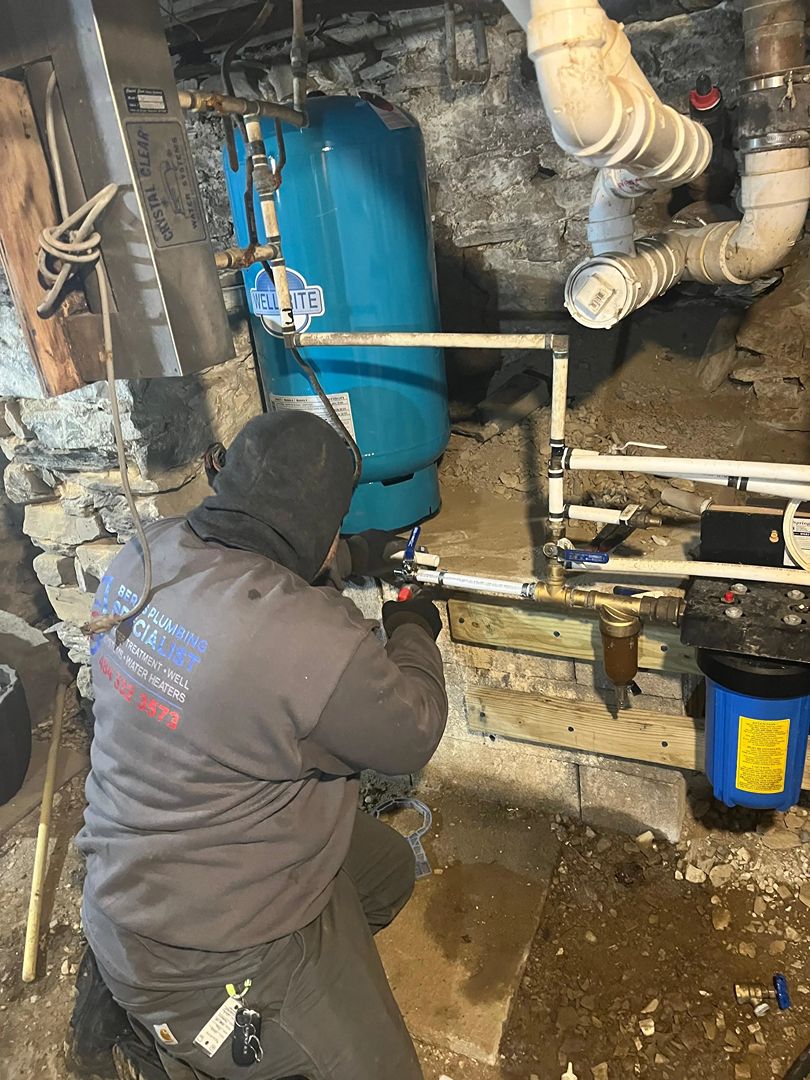
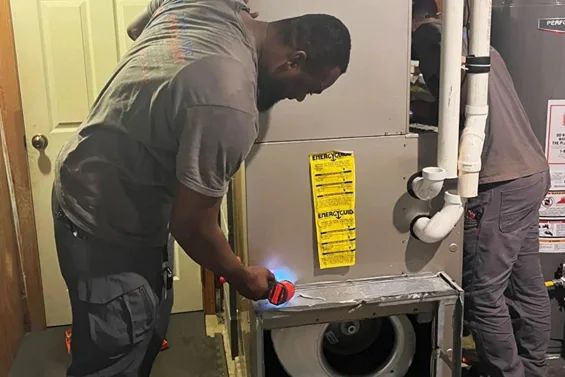
One reviewer of the company below, at an East Bellevue Avenue address in Muhlenberg Township, writes: "They installed our new water heater very professionally and cleaned up after themselves."
201 East Bellevue Avenue, Reading, PA
Speed matters when the tank goes, and one reviewer of the Wyomissing company below puts a clock on it: "Found a water heater leak at 6pm on a Thursday, new one was in and running by noon the next day."
845 N Park Road, Wyomissing, PA
Two more with water heater work in their reviews: a reviewer of Agosto Plumbing & Remodeling describes a plumber coming out at 11 p.m. to get a water heater repaired, and a reviewer of Good Faith Plumbing LLC lists "replacing a hot water heater" among the jobs that company handled for them.
Frequently asked questions about water heater replacement cost.
How much does it cost to replace a water heater? Nationally, $1,600 to $5,400 installed with $1,950 given as the average, per a national cost guide updated June 2026, or $600 to $2,500 for a tank and $1,000 to $4,000 for tankless, per a national guide updated January 2026. Those are national reference points, not Berks County quotes. Get two or three local quotes on the same scope before you decide anything.
Do I need a permit to replace a water heater in Berks County? Pennsylvania's default is yes: 34 Pa. Code 403.62(a) requires a permit before replacing a plumbing, mechanical or gas system regulated by the Uniform Construction Code, and water heaters are not in the exemption list. What varies is the local fee and paperwork, which is what the municipality table above lays out. If the failure is an emergency, subsection (b) allows the replacement to go ahead as long as the permit application follows within three business days.
Is a tankless water heater worth it in Berks County? It depends on two things a brochure cannot see: what your gas line, venting and electrical panel need, and how hard your water is. Labor alone runs closer to 50 percent of the total on a gas tankless job versus around 20 to 25 percent for a tank, per a national guide updated January 2026. And one manufacturer's manual makes water treatment a requirement above 200 mg/L and excludes scale damage from the warranty, so get your hardness number first.
Do I need a water softener with a new water heater? Not automatically, and for a gas storage tank the national laboratory that studied this for the Department of Energy calls a softener a last resort, because it adds expense and "may decrease tank life," with softened water able to cut tanked water heater life by 50 percent or more. It says a softener is not required for electric storage or heat pump water heaters on equipment performance grounds. Tankless is the case where hardness drives the decision.
How long does a water heater last? Published estimates differ. The national cost guides in the sources below put a tank at about 8 to 12 years and a tankless unit at 15 to 20. The figure with failure data behind it comes from an insurance research institute's 2007 analysis of water heater water-loss claims, reported by the national laboratory: the average age at failure was 10.7 years, ranging from 1 to 30 years.
A water heater is the least interesting thing you will ever spend two thousand dollars on, and one of the few you will use every single day until it quits. Pick the type, write down the gallons, settle your temperature setting, find your hardness number, and put a plumber's name in your phone.
Then forget about it. That is the reward.
Sources
- This Old House, "How Much Does Water Heater Installation Cost?" (updated 06/17/2026): the national $1,600 to $5,400 range and $1,950 average, tank cost by capacity, hourly plumber rate, permit, disposal and expansion tank figures.
- Fixr, "How Much Does Water Heater Installation Cost in 2026?" (updated January 27, 2026): national installed cost by type and by tank capacity, hourly labor, old unit removal and permit ranges.
- Fixr, "Gas Water Heater Cost" (updated January 30, 2026): gas tank and gas tankless installed ranges, the 20 to 25 percent versus roughly 50 percent labor shares, and gas venting cost.
- Fixr, "Electric Water Heater Installation Cost" (updated January 27, 2026): electric tank and hybrid electric installed ranges, and the dedicated 240-volt outlet and circuit breaker costs.
- This Old House, "Tankless Water Heater Installation Cost" (updated 06/12/2026): the tankless installed range and average, gas line conversion, stainless venting, new circuit, panel upgrade and permit figures.
- ENERGY STAR (U.S. Environmental Protection Agency), "Save More with ENERGY STAR Certified Heat Pump Water Heaters": the annual savings, payback and lifetime savings figures by household size versus a standard electric water heater.
- ENERGY STAR (U.S. Environmental Protection Agency), "Heat Pump Water Heaters": the 40 to 90 degree installation range, the 1,000 cubic feet of air space, the space-cooling effect and the cold-weather back-up electric mode.
- ENERGY STAR (U.S. Environmental Protection Agency), "What is Uniform Energy Factor and why does it matter?" (April 29, 2024): UEF as the Department of Energy's standard measure, and the four usage bins with comparison only within a bin.
- Internal Revenue Service, "Energy Efficient Home Improvement Credit" (last reviewed or updated 28-Apr-2026): the credit covering improvements made through December 31, 2025, the $2,000 annual cap, and heat pump water heaters as qualifying property.
- Pacific Northwest National Laboratory, "Impacts of Water Quality on Residential Water Heating Equipment," PNNL-22921 (November 2013): the 140 versus 120 degree scale calculation, the up-to-10-percent efficiency figure, the ASHRAE boiler figure, the softener "last resort" and 50-percent-or-more soft water findings, the tankless efficiency study and its funder, the 10.7-year average age at failure, and the bacteria-growth caution attached to reducing tank temperature setpoints.
- U.S. Occupational Safety and Health Administration, Legionnaires' disease: that airborne exposure to environmental sources of Legionella "can cause disease, especially in older and immunocompromised people." This is the guidance the national laboratory cites when it cautions about reducing tank temperature setpoints.
- Rinnai America, "SENSEI RX Residential Installation and Operation Manual," document 100000839: the water treatment thresholds by mg/L and grains per gallon, the temperature acceleration statement, and the lime and scale warranty exclusion.
- Penn State Extension, "Water Softening" (updated September 8, 2025): the hardness classification table in grains per gallon and mg/L used to read a water test.
- Penn State Agricultural Analytical Services Laboratory, Berks County drinking water test summary, 9/12/2007 to 6/16/2025: the 464-sample summary and the hardness median of 61.7 mg/L across 190 samples, with minimum and maximum.
- U.S. Geological Survey, "Water Resources of Oley Township, Berks County, Pennsylvania," Water-Resources Investigations Report 87-4065 (1988): the township's carbonate geology, the 110 to 1,152 mg/L hardness range with a 265 mg/L median, and the report's own caution about non-geologic factors.
- Pennsylvania Geological Survey, Gary M. Fleeger, "The Geology of Pennsylvania's Groundwater," Educational Series 3 (third edition, 1999): limestone and dolomite as the rock type whose listed natural water-quality problem is hardness, and their prevalence in southeastern Pennsylvania valleys.
- PPL Electric Utilities, current electric tariff, territory covered: the Berks County boroughs and townships in PPL service territory.
- PPL Electric Utilities efficiency program, heat pump water heater rebate: the $400 rebate, the Uniform Energy Factor 3.3 requirement, and the closed window for equipment installed on or before May 31, 2026.
- FirstEnergy Pennsylvania, energy saving programs: the statement that the company is working to finalize new programs.
- UGI Utilities, Residential Equipment Program rebate application: the $400 ENERGY STAR tankless water heater rebate and its October 1, 2025 to September 30, 2026 installation window.
- UGI Utilities, natural gas in Reading and Berks County: the over 82,000 homes figure and the 150-foot connection offer with its exclusions.
- U.S. Census Bureau, American Community Survey 2024 five-year estimates, tables B25034, B25035 and B25040 (retrieved via Census Reporter): Berks County housing age, median year built, and heating fuel shares against the state and national figures.
- Pennsylvania Department of Labor and Industry, Uniform Construction Code municipal elections: which Berks municipalities enforce the code, and Albany Township as the county's lone opt-out.
- 55 Pa.B. 7701, Uniform Construction Code rulemaking (November 8, 2025): Pennsylvania's adoption of the 2021 International Code Council codes effective January 1, 2026.
- International Residential Code 2021 as adopted in Pennsylvania, chapter 28, water heaters: sections P2804 relief valves, P2801.6 the pan and P2801.2 the drain valve.
- International Residential Code 2021 as adopted in Pennsylvania, chapter 29: section P2903.4.2, thermal expansion control.
- International Residential Code 2021 as adopted in Pennsylvania, chapter 24, fuel gas: section G2407, combustion air.
- Penn State Agricultural Analytical Services Laboratory, Pennsylvania drinking water test summary: the statewide hardness median of 85.4 mg/L across 8,244 samples.
- 34 Pa. Code § 403.62, "Permit requirements and exemptions": the permit requirement for replacing a regulated plumbing, gas or mechanical system, the exemption list, and the three-business-day emergency provision.
- Cumru Township, "Building/Zoning Permit Fee Structure": the $60.00 hot water heater line and the $50.00 processing fee under mechanical permits, and the change-of-fuel-source heading above them.
- Exeter Township, 2026 Fee Schedule: the $50.00 hot water heater replacement line under plumbing permit fees and the $75.00 minimum plumbing permit fee.
- Borough of Kutztown, Plumbing Permits information sheet: that permits are required for new or replacement water heaters, and the $35.00 application fee and $70.00 fixture minimum.
- Muhlenberg Township, Permitting Overview and Guide: that the plumbing permit is the one used for water heaters.
- Township of Spring, 2026 Fee Schedule: the "H20 heaters" mechanical permit heading and the $90.00 per required inspection fee plus $4.50.
- Borough of Wyomissing, 2026 Fee Schedule: the mechanical permit section naming "H20 heaters" and its $150.00 fee plus $4.50.
- Township of Spring, Township Permits: the mechanical application instruction naming water heaters.
- Borough of Wyomissing, Permits: the general Uniform Construction Code permit requirement and the borough's statement of the three-business-day emergency rule.
- Borough of West Reading, Code Enforcement: the permit requirement for replacing an electrical, gas, mechanical or plumbing system.
- Borough of West Reading, Permits and Fees: the same-location fixture swap note and the $150 plus $4.50 minor building permit fee.
- City of Reading, Permit Cost Estimator: that the city prices permits by project cost rather than by appliance, plus the state fee.