Allen R. Moyer & Son Excavating, Inc. is an excavating contractor based at 105 N Elm St in Wernersville, Pennsylvania, a small borough in western Berks County located along the Route 422 corridor between Reading and Lebanon. The company operates in the site work and earthmoving trade, a field that covers the preparation of land for construction, the installation of underground infrastructure, and the shaping of ground surfaces for drainage and access. The business can be reached by telephone at +1 610-670-2890.
As the company name indicates, the firm is structured as a family enterprise, with the founder's name and a second generation reflected in the title. This pattern is common among excavating contractors in southeastern Pennsylvania, where many earthmoving operations began as small owner-operated outfits and expanded gradually by adding equipment, operators, and a broader range of services. Contractors of this kind typically build long working relationships with local builders, engineers, plumbers, concrete crews, and municipal officials, and much of their work arrives through referral rather than advertising.
What Excavating Contractors Do
Excavating contractors occupy an early and fundamental position in almost any construction sequence. Before a foundation is poured, a driveway is paved, or a utility line is energized, someone has to move soil and rock, establish grades, and open and backfill trenches. The scope of work handled by companies in this category generally includes some combination of the following:
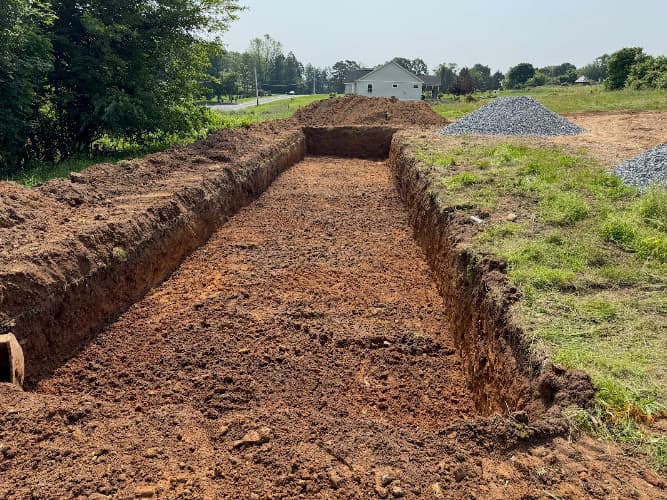
- Foundation and basement excavation for new residential and commercial construction, including digging to design depth, setting proper bearing conditions, and backfilling after walls are placed
- Site preparation and land clearing, including brush and tree removal, stump grubbing, topsoil stripping and stockpiling, and rough grading of a building pad
- Final grading and topsoil placement in advance of seeding, sod, or landscape installation
- Driveway construction and repair, including subbase preparation, stone placement, crowning for drainage, and culvert and pipe installation at road crossings
- Underground utility trenching for water service, sewer laterals, electric conduit, gas lines, and communication lines
- Stormwater management work such as drainage swales, French drains, downspout and roof drain lines, inlets, catch basins, dry wells, and infiltration beds
- On lot sewage disposal work, including septic tank and distribution box installation, absorption bed and sand mound construction, replacement of failing systems, and related repairs
- Demolition of outbuildings, barns, garages, silos, concrete slabs, and pools, along with debris removal and site restoration
- Retaining wall excavation, pond construction and cleanout, and erosion control measures such as silt fence, rock construction entrances, and riprap placement
- Hauling and delivery of bulk materials such as stone, modified, topsoil, and fill, and removal of surplus soil and spoils from a job site
Not every excavating company performs all of these tasks, and prospective customers are encouraged to confirm current service offerings directly with the office by telephone.
Location and Service Area
Wernersville sits in Lower Heidelberg and South Heidelberg township territory in the Lebanon Valley portion of Berks County. The surrounding area combines older borough housing stock, newer suburban subdivisions, and a substantial amount of farmland and wooded hillside along South Mountain and the Furnace Hills. Each of these settings presents different excavation conditions: tight lots with limited access and mature trees in the boroughs, engineered subdivisions with stormwater requirements in the townships, and long lanes, springs, and variable soils on rural parcels.
Excavating contractors based in this part of the county commonly work throughout western and central Berks, including communities such as Sinking Spring, Robesonia, Wernersville, Mohnton, Shillington, Reading, Leesport, and Kutztown, with occasional travel into neighboring Lancaster, Lebanon, and Schuylkill counties depending on the size of the project. Travel range often depends on the scale of the work, since mobilizing tracked equipment, trucks, and trailers to a distant site adds cost that is easier to absorb on a large job than a small one. Customers outside the immediate area should ask about service radius when requesting an estimate.
Regional Ground Conditions
Berks County geology is varied, and it has a direct effect on excavation work. Portions of the county sit over carbonate rock, where sinkholes, voids, and pinnacled limestone can complicate foundation and utility work. Other areas contain shale, sandstone, and quartzite that may require rock hammering or careful blasting by a specialty subcontractor. Clay soils and seasonal high water tables influence how trenches are shored, how backfill is compacted, and where stormwater can realistically be infiltrated. Experienced local operators are generally familiar with these conditions and can adjust methods, equipment, and material selection accordingly, which is one practical advantage of hiring a contractor who works regularly in the same townships.
Permits, Utilities, and Compliance
Earthmoving in Pennsylvania is subject to several layers of oversight that affect scheduling and cost. Before digging, contractors are required to notify the Pennsylvania One Call System so that utility owners can mark underground facilities, a process that carries a defined waiting period. Projects that disturb larger areas of ground may require erosion and sediment control plans reviewed by the Berks County Conservation District, and stormwater management plans are commonly reviewed at the township level. On lot sewage systems fall under the jurisdiction of the Pennsylvania Department of Environmental Protection and are administered locally by municipal sewage enforcement officers, who conduct soil testing and inspect installations. Driveway entrances onto state roads require a highway occupancy permit from PennDOT, while township roads are handled by the local municipality.
Customers often find it useful to clarify at the outset who is responsible for obtaining each permit, scheduling inspections, and coordinating with engineers or surveyors, since responsibility can be divided between the property owner, the general contractor, and the excavator.
Practical Information for Customers
Excavation estimates are usually developed after a site visit, because access, slope, soil type, spoil disposal, and the location of existing utilities all influence the price more than square footage alone. When contacting the company, it helps to have available any site plans, septic permits, property surveys, or engineering drawings, along with a clear description of the intended finished result. Seasonality also matters in this trade: frozen or saturated ground can delay digging, grading, and seeding, so spring through late fall is typically the busiest stretch for earthwork in the region, and lead times may be longer during those months.
For current availability, service details, equipment capabilities, and scheduling, Allen R. Moyer & Son Excavating, Inc. can be contacted at its Wernersville office by telephone.