Federal Pacific, Zinsco and Fuse Boxes in Berks County Homes
How to tell from the label whether your panel is a Federal Pacific, a Zinsco or a fuse box, what the record says about each, and what replacing one costs in Berks County.
Open the panel door and read the label, not the breaker colors. If it says Federal Pacific, FPE, Stab-Lok or Zinsco, have a Berks County electrician look at it and plan on replacing it. Home inspectors say replace; the federal safety agency confirmed a testing problem years ago and never ruled on whether the breakers are safe. If it's a fuse box, the box itself isn't the hazard; the wrong size fuse is, and that's a cheaper fix.
How to tell which panel you have from the label.
The label settles it. A Federal Pacific panel says so on the face or inside the door: Federal Pacific Electric, Federal Pacific, FPE, Federal Electric, Federal NOARC or Federal Pioneer, usually with Stab-Lok, the breaker line's name.
A Zinsco panel has two tells. The label is blue and silver and says Zinsco; panels made after the brand changed hands say Sylvania, Sylvania-Zinsco or GTE-Sylvania-Zinsco instead. The word Magnetrip is often embossed into the panel face. The other tell is the handles, which Zinsco colored by size: light blue for 15 amps, red for 20, light green for 30, gray for 40, black for 50 and white for 60. A rainbow of handles behind one door is a Zinsco tell.
You might be wondering about red handles. Some Federal Pacific breakers have red handle faces and some don't, and red is also Zinsco's 20-amp color, so a red handle by itself points at either brand or at nothing.
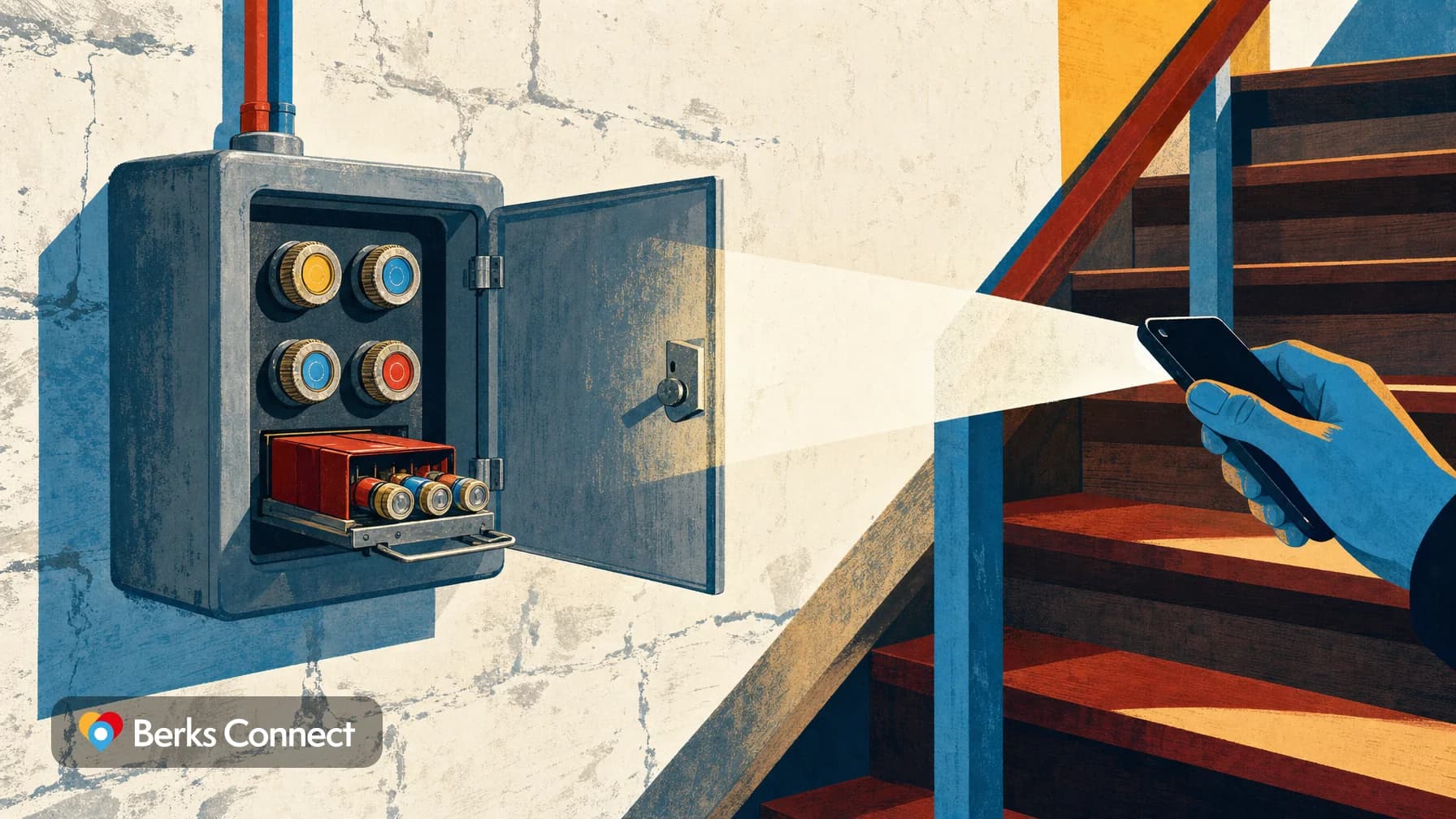
A fuse box has no handles at all. You'll see round fuses that screw in on the same thread as a light bulb, plus one or two blocks you pull straight out that hold cartridge fuses; those pull-outs are the main switch. A classic four-fuse panel is 60-amp service. Fuse boxes were the norm until breaker panels came along in the 1950s, and plenty of houses built into the late 1960s still got one.
What was found wrong with Federal Pacific Stab-Lok breakers, and what wasn't.
UL listing is the safety lab's stamp that a breaker passed a set of tests. The federal Consumer Product Safety Commission investigated Federal Pacific Stab-Lok breakers from 1980 to 1983, after reports that many of them didn't meet those UL requirements, and the Commission's own testing confirmed that the breakers failed some of the calibration tests the stamp requires. The investigation focused mainly on breakers made before 1979.
What the Commission never did is answer whether the breakers are unsafe. It closed the investigation without deciding: the data it had didn't prove a serious risk, and it never said the breakers were safe either. In 2011 it put that in writing, a note saying it had closed the matter without any determination about the breakers' safety. So: a confirmed testing failure, an open safety question, and no recall on Federal Pacific, Stab-Lok or Zinsco.
A New Jersey court also found that Federal Pacific Electric violated that state's consumer fraud law through fraudulent conduct in the testing it used to obtain its UL listing. That's a finding about how the testing was done, not a finding that the panels start fires. The case settled in 2008, and it applied to breakers made from June 29, 1971 to July 1, 1980.
What is known about Zinsco panels.
Zinsco panels were never recalled, and the federal testing record above is about Federal Pacific; it doesn't mention Zinsco. Home inspectors describe the same problem with them consistently: the breakers clip onto an aluminum bus bar, the metal strip inside the panel that feeds them power, and that connection can overheat. Inspectors are trained to recommend evaluation and possible replacement when they see one.
Zinsco moved to aluminum bus bars in the mid-1960s, and the brand was sold to Sylvania in the early 1970s, which is why later labels carry that name. Whichever label yours has, the next step is the same as for Federal Pacific: have an electrician evaluate it.
Are fuse boxes safe?
Mostly yes. The box isn't the hazard; the fuse in it can be. The electrical code lets an existing fuse panel stay in service as long as there's no sign of oversized fuses or tampering, and the federal safety guidance on fuses is entirely about size, not the box. A fuse of the right rating protects the wiring behind it. The hazard is a bigger fuse screwed into a socket that accepts any size, say a 30-amp fuse where a 15-amp circuit's fuse belongs, because now the wire carries more current than it was made for before the fuse blows.
The fix is specific. An electrician fits the sockets with Type S inserts, fittings screwed into each fuse socket that only accept a fuse of the right size and can't be taken back out. If a fuse blows, don't answer it with a higher-amp one. Old isn't the problem by itself; the wrong fuse is.
Who says replace it, and how much weight each voice carries.
Three voices say something about replacement, and they don't carry the same weight. The federal government has never told homeowners to replace these panels; its only advice is general: know which circuit feeds what, don't overload them, and if a fuse blows or a breaker trips, find out why instead of resetting it and walking away. The post on what to check when a breaker keeps tripping covers that hunt.
The home inspection industry is where "replace it" comes from. Its own published guidance says complete replacement with modern equipment remains the best recommendation, and inspectors are trained to hand the evaluation of a Federal Pacific panel to a licensed electrical contractor and to recommend evaluation and possible replacement of a Zinsco. The third voice is an independent engineer who tested these breakers for years, and he concluded the panels should be replaced for electrical and fire safety. That's one engineer's conclusion.
You might be wondering whether you can just swap the breakers. Home inspectors' guidance says most replacement breakers sold for these panels aren't UL-approved, so swapping breakers doesn't fix anything.
Which Berks County homes date from the years these panels were sold.
The year your house was built tells you where to look, not what's inside. About three in ten Berks homes, roughly 53,000 of the county's 172,000, were built between 1950 and 1979, the decades these breaker panels date from. A 1965 house may have had its panel replaced twice since then. The figures below cover only the larger municipalities, the ones with 4,000 or more homes, so if your town isn't listed, the county row is your number.
| Municipality | Homes built 1950 to 1979 | Share of its homes |
|---|---|---|
| Reading | about 8,900 | 25 percent |
| Spring Township | about 5,000 | 43 percent |
| Exeter Township | about 3,400 | 33 percent |
| Muhlenberg Township | about 3,200 | 36 percent |
| Cumru Township | about 3,000 | 43 percent |
| Wyomissing | about 2,200 | 41 percent |
| Amity Township | about 1,700 | 34 percent |
| Berks County as a whole | about 53,200 | 31 percent |
Spring, Cumru and Wyomissing stand out: more than four in ten homes in each were built in those decades. Reading has the most such houses but the smallest share on the list, because so much of the city went up before 1950. A house that old is likelier to have a fuse box than one of these breaker panels. About a third of all Berks homes and two thirds of Reading's date from before 1950, and the panel upgrade cost post was written for exactly those houses.
What replacing a panel costs and what to do next.
Now the money. As of 2026, replacing a Federal Pacific or Zinsco panel with a new breaker panel runs $1,500 to $4,000, and that figure includes some wiring work along with the panel, because these are older systems. Replacing a fuse box with a breaker panel runs $1,500 to $4,500. Both are national figures, so a Berks quote can land outside them. If the electrician suggests moving to 200-amp service while the panel's open, that's a different job, and the post on electrical panel upgrade cost in Berks County walks through it.
If you're the buyer holding the inspection report, Pennsylvania doesn't license home inspectors; instead the law makes the sales agreement call for a full member of a national home inspection association (a licensed engineer or architect, or someone a full member supervises and signs for, also qualifies), and it says what the report has to contain. Any material defect gets described, one that poses an unreasonable risk to people has to be conspicuously flagged, and whether a panel rises to that is the inspector's judgment. The inspector can't give a repair price unless the report names its source and states a range.
Tonight's job is short. Read the label, decide whether it says Federal Pacific, Zinsco, or neither, and call a Berks County electrician to evaluate it. Until the appointment, the general advice above is the whole list: don't overload circuits, and if a breaker trips, find out why instead of resetting and forgetting. The post on what a licensed electrician means in Pennsylvania explains what licensed means in Pennsylvania, and the guide to hiring home services in Berks County covers getting a quote you can compare. No rule puts a deadline on replacing one of these panels, and the electrician who opens yours is the one who can tell you whether it's a this-month job or a this-year one. Let the electrician look, then decide.
Can I just replace the breakers instead of the panel?
Not as a fix. Home inspectors' own guidance says most replacement breakers sold for these panels aren't UL-approved, so you'd be putting unlisted parts into an old panel. Their recommendation is full replacement.
My inspector wrote "recommend evaluation." Is that a big deal?
It means what it says. Inspectors are trained to hand the full evaluation of a Federal Pacific panel to a licensed electrical contractor rather than judge it themselves, so the report says "evaluate" instead of "unreasonable risk" or "fine." It isn't a verdict; it's an instruction to get one, so the number you negotiate over is a quote instead of a guess.
Will my insurance company care?
Maybe. Pennsylvania's insurance regulator has no rule about these panels, and its homeowners guide says only that premiums are often higher for older homes and homes in poor condition. Home inspectors, though, are taught that many carriers decline or charge more for a house with a fuse panel, so ask your own agent before you assume either way.
Sources
- U.S. Consumer Product Safety Commission, Release 83-008, "Commission Closes Investigation of FPE Circuit Breakers" (March 3, 1983, revised February 18, 2011): the 1980 to 1983 investigation, the confirmed calibration-test failures, the closure without a safety determination, the 2011 note, and the general precautions for all breakers and fuses.
- CPSC recall database (saferproducts.gov), queried for Federal Pacific, Stab-Lok and Zinsco (September 2026): zero recalls for any of the three.
- Reproduced class-action legal notice, Yacout v. Federal Pacific Electric Co., Superior Court of New Jersey, Law Division, Middlesex County, Docket L-2904-97: the consumer-fraud finding on UL testing and labeling, the 2008 settlement, and the June 29, 1971 to July 1, 1980 breaker class.
- InterNACHI, "Inspecting the Main Electrical Panelboard During a Home Inspection": the inspection industry's replacement recommendation, the absence of recalls, and the note that most aftermarket replacement breakers for these panels are not UL-approved.
- InterNACHI, "Electrical Service Panels": the label names for Federal Pacific panels and the Zinsco label and Magnetrip embossing.
- InterNACHI, "How to Perform Residential Electrical Inspections," 4th edition (revised December 2013): fuse panels as the norm until the 1950s and into the late 1960s, 60- or 100-amp fuse panels, Zinsco's aluminum bus bars from the mid-1960s and the early-1970s sale to Sylvania, and the guidance that inspectors defer Federal Pacific evaluation to a licensed electrical contractor and recommend evaluation and possible replacement of a Zinsco.
- InspectAPedia, "Identify Federal Pacific Electric FPE Stab-Lok Circuit Breakers and Electrical Panels" and InspectAPedia, "Identify Zinsco and GTE Sylvania-Zinsco Electrical Panels": where the Federal Pacific name appears on the label, the red toggle faces on some but not all breakers, and Zinsco's handle colors by amperage.
- CPSC log of meeting, March 18, 2008, with the attached handout "Hazardous FPE Circuit Breakers and Panels" by Jesse Aronstein, Ph.D., P.E. (an outside engineer's submission hosted by CPSC, not a CPSC finding): the engineer's conclusion that the panels should be replaced, the mid-1960s to early-1980s production window, and the note that handle color and style varied over the years.
- CPSC Publication 518, "Guide to Home Wiring Hazards": what a fuse panel looks like, the four-fuse 60-ampere panel, the Edison-base socket problem, Type S inserts, and the rule against a higher-amp fuse.
- CPSC Publication 513, "Home Electrical Safety Checklist" (July 2008): fuses of the correct size for the circuit.
- IAEI Magazine, "Article 240, Part 2, Overcurrent Protection" (March/April 2013): the National Electrical Code's rule that Edison-base fuses are used only for replacements in existing installations with no evidence of overfusing or tampering, and the Type S adapter that cannot be removed once installed.
- InterNACHI Residential Standards of Practice, section 3.7 (revised October 2022): what a home inspector inspects and describes at the service panel.
- 68 Pa.C.S. Chapter 75, Home Inspections (Pennsylvania General Assembly): no state license for home inspectors, the sales-agreement requirement, the required contents of a report, conspicuous identification of a material defect that poses an unreasonable risk, and the rule on repair-cost estimates.
- Pennsylvania Insurance Department, "Homeowners Insurance Guide" (revised April 2017): the state's published position on older homes and premiums; no rule about electrical panels.
- HomeAdvisor, "How Much Does It Cost to Replace or Upgrade an Electrical Panel?" (updated June 17, 2026): the $518 to $2,192 like-for-like range and $1,346 average, $1,500 to $4,500 for a fuse box to breaker panel, and $1,500 to $4,000 for a Federal Pacific or Zinsco replacement including some wiring work. National figures, as of 2026.
- U.S. Census Bureau, American Community Survey 2020-2024 5-year, table B25034, Berks County and its municipalities: homes built 1950 to 1979 (the sum of the 1950-59, 1960-69 and 1970-79 columns) and the pre-1950 share, pulled September 2026.