Outlet Not Working in Berks County? What to Check First
A dead outlet is usually a tripped GFCI or a tripped breaker. Here is how to find either one in five minutes, what not to touch, and when it is a call to an electrician.
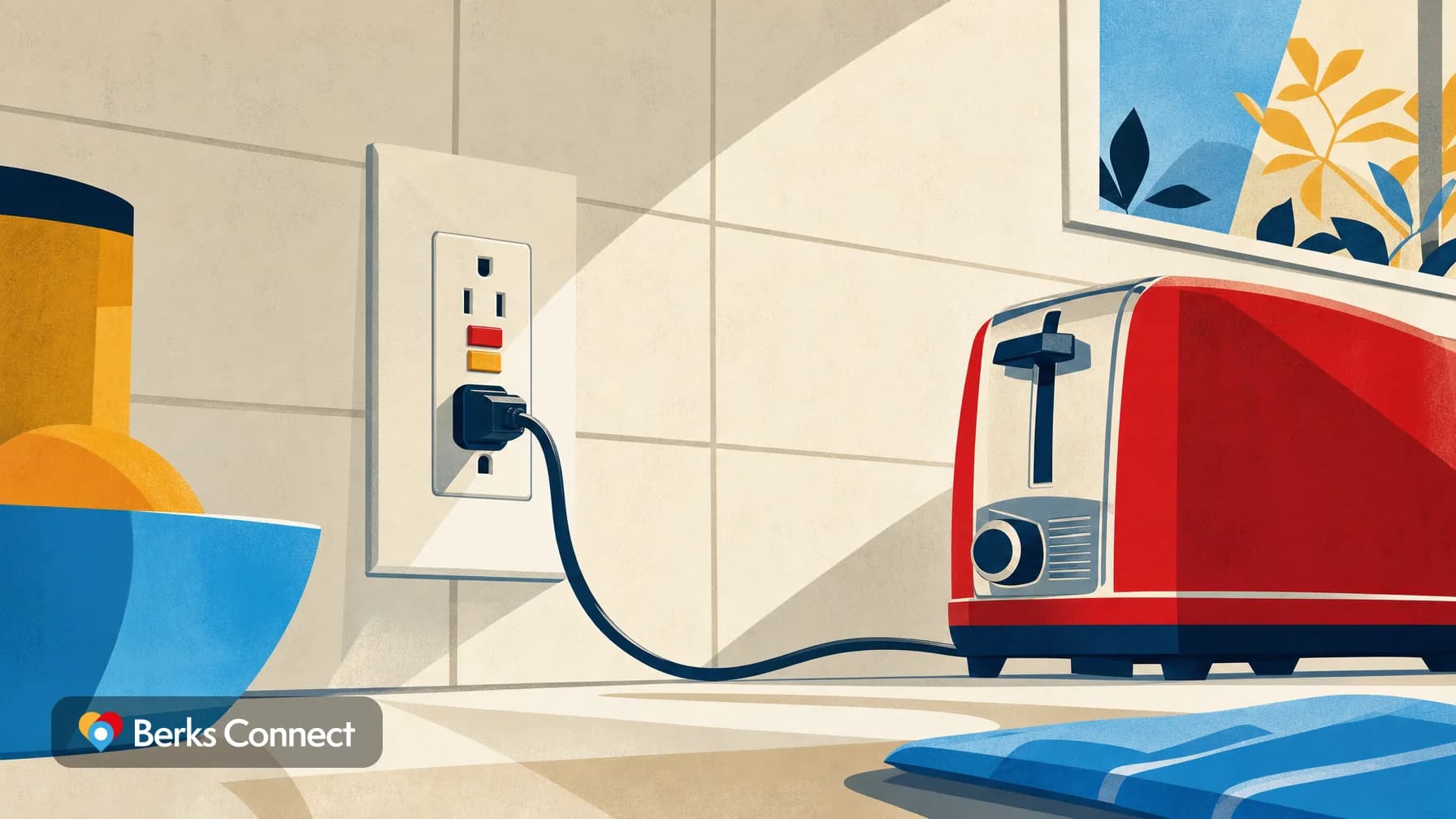
Go find a GFCI outlet and press RESET, and press it on every one you find. That's the one with the small TEST and RESET buttons on it, and it's the first thing to rule out when an outlet quits. The catch is that it's often not in the room you're standing in, so you'll be walking the house.
While you're hunting, keep one thing in mind. A dead outlet is a symptom, not the problem itself. The cause is often something ordinary, and the checks below will tell you fast. If they don't turn it up, the problem is behind the wall or out at the pole, and either way that's when you stop and call. The Berks County electricians page is where I'd start. And if anything is hot, smoking, sparking or buzzing, skip the checks and go straight to the section below called When to stop and call.
Start with the GFCI outlets, even the ones in another room.
A GFCI is a small safety device built into an outlet. It measures the current going out and the current coming back. If even a tiny amount goes missing, it cuts the power, because missing current means electricity is leaving the circuit somewhere it shouldn't, sometimes through a person. It's shock protection, and it's supposed to be twitchy. In some houses that protection is a GFCI breaker in the panel instead of an outlet on the wall, and the breaker section below covers that.
One GFCI also protects other ordinary outlets that share its circuit, so a plain-looking outlet in a bedroom or a dining room can be shut off by a GFCI in another room. Look at the dead outlet. If it has a small GFCI PROTECTED sticker on it, that's your answer: it's fed through a GFCI somewhere else, and you need to find that one. Plenty of outlets don't have the sticker, so you may be hunting blind.
So walk the house. Bathrooms, the kitchen counter, the garage, the basement, the laundry area, anywhere near a sink, and the outdoor outlets, including the ones on an outside wall or the porch. If you don't find one, that isn't strange. The rules that require them came in one room at a time from the 1970s on, and they apply to new construction and big remodels, not to a house that already stands. An older Berks house might have one GFCI added later that feeds more outlets than you'd expect, or it might not have any.
How to reset a GFCI and prove it's working.
- Press RESET.
- Plug a lamp into that outlet and turn the lamp on, so you can see whether the power is on.
- Press TEST. The lamp should go off. That's the device tripping itself on purpose.
- Press RESET again. The lamp should come back on.
If the lamp stays on when you press TEST, that GFCI isn't protecting you. It's either bad or wired wrong, and an electrician replaces it. If RESET brought your outlet back and it stays on, you're done. If that GFCI keeps tripping, something on its circuit is leaking current, and that's a call.
If it won't reset at all, it's telling you one of a few things. There's no power reaching it, usually because a breaker ahead of it is tripped, sometimes because of a loose connection ahead of it. Something plugged into it, or into a dead outlet it feeds, is still leaking current. Or it's miswired, which can happen when somebody replaced it recently. Or it failed its own self-test and is locking itself out on purpose, which means an electrician replaces it. Work through it in this order:
- Go to the breaker panel and look for a tripped breaker. If you find one, unplug what's on that circuit, then reset it.
- Come back and press RESET again.
- If it still won't hold, unplug everything on that outlet and everything plugged into any other dead outlet, then press RESET one more time.
- If it holds now, one of the things you unplugged was causing the fault. Plug them back in one at a time and you'll find it. Leave that one unplugged and get it repaired or replaced.
- If it still won't hold with nothing plugged in, it has either failed or is catching a fault that's still there. Either way, stop there and call an electrician.
Next, the breaker panel.
If no GFCI explains it, open the panel door and look down the row. A tripped breaker doesn't always snap over to OFF where you can spot it. It can sit somewhere between ON and OFF, sometimes close enough to ON that your eye slides right past it.
- Unplug whatever is on that circuit first, so you're not asking the breaker to carry a load the second it comes back. If the panel labels don't tell you what's on it, everything that went dead is on it.
- Push the handle all the way to OFF. A tripped breaker won't reset from that halfway spot, and this is where people give up.
- Push it all the way to ON.
- Go check your lamp.
If one of the breakers has its own TEST and RESET buttons, that's a GFCI breaker, and it resets the same way, OFF and then ON. Do all of this with dry hands and dry shoes on a dry floor, which is worth saying out loud in a Berks basement after a hard rain. And if that breaker trips again, or trips every time one particular outlet or appliance gets used, stop and call. A breaker that keeps tripping is doing its job. Don't let anyone talk you into a bigger breaker. I've written up what to check when a breaker keeps tripping separately, if that's where this is heading.
Then try the wall switches.
This one's almost funny when it turns out to be the answer. A standard outlet has two halves, and a small metal tab joins them. An electrician can snap that tab off so the two halves get fed separately. That's how a switch by the door controls a lamp plugged into the top half while the bottom half stays live all the time.
So a dead outlet in a living room or a bedroom is sometimes just the switched half, with the switch flipped off. Test both halves with your lamp, top and bottom. Then flip every switch in the room, including the one nobody in your house has ever figured out.
When it's none of those three, your part is done.
If you've reset every GFCI, reset the breaker, and tried the switches, and the outlet is still dead, the cause is behind the cover plate, and that's the end of your part. The one exception is a storm or an outage, and that has its own section below.
Plenty of outlets, especially in newer houses, are wired with push-in connections on the back, where the wire is stabbed into a hole instead of clamped under a screw. Those connections can loosen and overheat over time. Outlets on a circuit are wired in a chain, and the power for the next outlet often passes through the connections of the one before it. So one loose connection can kill every outlet after it. A loose connection also runs hot, which is why this matters. Finding it is a job for an electrician with a meter, not for you with a screwdriver, so leave the plate on the wall.
Until the electrician comes, don't plug anything into that outlet, and if it bothers you, turn off the breaker for that circuit and leave it off.
When to stop and call.
Some signs mean you skip the checks entirely and call today:
- An outlet or switch plate that's hot. Unplug what's in it and leave that switch alone. Warm can be normal, and dimmers run warm. Painful to touch is not normal.
- A teardrop-shaped dark mark on the wall above an outlet or a switch.
- A burning smell.
- Buzzing, sizzling or crackling from an outlet or from the panel.
- Sparks.
- A tingle from anything you touch.
- A GFCI face that's discolored, cracked or warped.
- Plugs that fall out of the outlet on their own.
- Lights that flicker or dim.
Opening the panel door is fine. Never take off the screwed-on cover behind it. If you rent, call your landlord too.
After a storm, an outage, or water.
Check the GFCIs again after a storm, even the ones you already reset. Lightning and the power company's own switching can damage them, so test every GFCI in the house after a power failure. Then go look at the breakers.
Your house is fed by two live lines plus a neutral, usually from the pole. If about half the house is dead or dim and no breaker is tripped, one of those live lines may be out. That's often the utility's side, so call them first and let them tell you whether it's theirs or yours. Met-Ed serves much of Berks County. When you report it, tell them it's flickering, dimming, or some lights out, which is one of the choices they give you. The number is 1-888-544-4877. If your utility is PPL, use the number on your bill. Don't touch the meter or anything between the pole and the house, and if you see a line down, call 911 and keep everyone at least thirty feet back.
If the outlet or the panel was underwater, don't reset a thing. An electrician looks at it first.
If the fix turns out to be a new outlet, whether it needs a permit depends on your town. The state leaves that call to each town, and the electrician you hire will already know what yours wants. What the visit costs is in the post on what electricians charge per hour in Berks County, and if you've never hired a trade in the county before, the guide to hiring home services in Berks County covers how to pick one and what to ask.
Work the three checks in order tonight, and you'll either have your outlet back or you'll know exactly what to say when you call. Once things are calm, run that lamp test on every GFCI in the house, and do it again once a month. When it's the call, the Berks County electricians page is where I'd start.
Sources
- ESFI, "How to Use GFCIs", ESFI, "Ground Fault Circuit Interrupters (GFCI)" and ESFI, "Understanding Your Home Electrical System": what a GFCI does, GFCIs as breakers or outlets, the rooms where they're required, the test steps, finding and resetting a tripped breaker, the two 120-volt lines feeding a house, and leaving the meter alone.
- CPSC, "What is a GFCI?" (Publication 099): how small a leak trips a GFCI, protection for outlets downstream, the years each location was added to the code, and testing after a power failure.
- CPSC, "Guide to Home Wiring Hazards" (Publication 518): a dead outlet or switch as a warning sign, push-in connections loosening and overheating, power to one outlet passing through the connections of another, never removing the panel cover, and calling the power company for trouble at the service drop.
- CPSC, "Home Electrical Safety Checklist" (Publication 513): warm outlets, loose-fitting plugs, and resetting a GFCI breaker.
- Leviton, GFCI receptacle instruction sheet, Leviton, "How to Reset a GFCI Outlet After Lockout" and Leviton, T5325 outlet instruction sheet: the GFCI PROTECTED sticker, why a GFCI won't reset, the homeowner sequence, damage that means replacement, and the break-off tab between the two halves of an outlet.
- ESFI, "Indoor Electrical Safety Check": the tripped handle sitting close to ON, unplugging before a reset, the teardrop mark above a plate, and warm versus hot.
- ESFI, "How to Test a GFCI", ESFI, "Flood Electrical Safety" and CPSC, "Survival Tips After a Hurricane Strikes": lightning and utility switching damaging GFCIs, dry hands at the panel, and not re-energizing outlets or breakers that have been under water.
- NFPA, "Electrical Safety Tip Sheet": the call-an-electrician-or-your-landlord list.
- Siemens, "AFCI and GFCI Homeowner's Guide" and Schneider Electric, "What is the handle position of a QO branch breaker when ON, OFF and tripped?": pushing the handle fully to OFF and then ON.
- FirstEnergy (Met-Ed), "Report Power Outage": the "Flickering, Dimming, or Some Lights Out" report category and 1-888-544-4877.
- 34 Pa. Code § 403.62 and 34 Pa. Code § 403.1: ordinary repairs need no permit, adding or relocating wiring isn't ordinary, and residential repairs are left to municipal ordinance.