Slate Roof Repair in Berks County: Repair, Replace, Cost
A slate roof with a few broken or slipped slates is almost always a repair, because slate outlasts the nails and flashing that hold it. What slate repair and a new slate roof cost, how long Pennsylvania slate lasts, Reading's historic district roof rules, and the Berks roofers who work on slate.
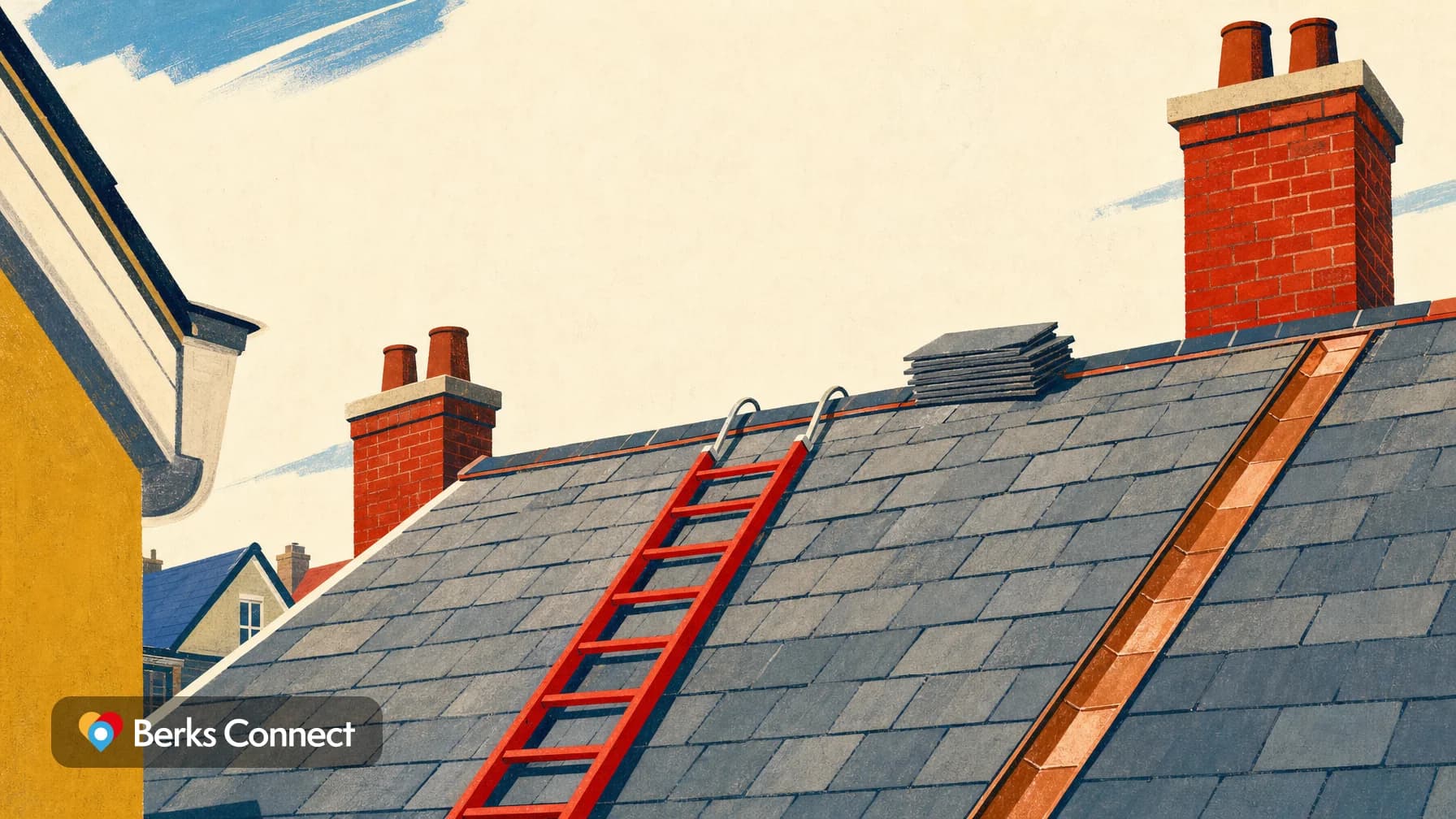
If a few slates are lying in your yard or a stain is spreading across an upstairs ceiling, the roof is almost certainly a repair, not a replacement. Slate outlasts the nails that hold it on and the flashing, the metal where the roof meets a chimney or a wall, so a roofer who works on slate fixes what's underneath and sets a matching slate properly: as of 2026 that's about $50 to $200 a slate nationally and a few hundred to about $1,500 for a typical visit. The whole roof usually comes off only when a fifth or more of the slates on a slope are broken, missing or sliding, or the slate itself has worn soft. Several of the roofers in Berks County list slate work; I'll name them below.
Can a slate roof be repaired, or does it all have to go?
The federal preservation brief on slate roofs, written for historic buildings, says historic slate roofs should be repaired rather than replaced whenever possible. Its rule for the other case is a count: "If 20% or more of the slates on a roof or roof slope are broken, cracked, missing, or sliding out of position," it's usually cheaper to replace than to fix each one. One national cost guide says it in dollars: replace when repairs approach half the cost of a new roof. Notice "or roof slope": slate wears unevenly, and one slope can be past that line while the others are repaired.
How long does a slate roof last, and what wears out first?
That depends on which slate is up there. The grayish-black slate from the Lehigh and Northampton quarries is one of the main types still on older slate roofs, and the trade calls it the softer, shorter-lived kind. The federal brief gives Pennsylvania soft-vein slate more than 60 years, and a Pennsylvania slater who wrote the trade's reference book gives it 75 to 125. A Pennsylvania slate roof around a hundred years old is inside those published ranges, and whether yours is done is a question for the face of the slate and the tap test, not the calendar. Berks has many: more than a quarter of the county's homes were built before 1940, and more than half of Reading's. Pennsylvania roofing slate is still quarried in the Slate Belt near Slatington, though special orders take months.
What gives out first is almost never the slate. Steel and galvanized nails rust out first, so slates slide and get salvaged and re-laid. Next comes the flashing. It's the weakest point in any roof and often wears out before the slate does, and the valleys, the troughs where two roof slopes meet, erode sooner than the other flashings.
Slate itself wears by flaking until it's worn soft and spongy and gives a dull thud when tapped. A look from the ground every year, clean gutters, prompt slate replacement and a slate specialist every five to seven years keep it that way. A storm that breaks slates is a different insurance question from a roof that's wearing out; the post on does homeowners insurance cover water damage explains which is covered.
What does slate roof repair cost?
A proper repair starts with a slate ripper, a long flat tool that hooks and pulls the nails out from under a slate. A matching slate slides in over the underlayment, the paper or membrane under the slates, and is held by a copper or stainless nail, covered by a bib, a strip of copper slid up under the slates above. The slate roofers' trade association's repair standard refuses three shortcuts: no roof cement, caulk or mastic on a slate's face; no nails or screws through the exposed face; and no exposed metal straps.
Nationally, that work runs about what the table shows; no Berks roofer prints a slate price.
| Slate roof work | National range, as of 2026 |
|---|---|
| Replacing one slate | $50 to $200 per slate |
| Re-nailing slipped slates (a typical job; the count sets the price) | $150 to $650 |
| Replacing flashing | $200 to $1,000 |
| A typical repair visit (a few slipped slates and some underlayment) | $300 to $1,500 |
| Re-slating a house already framed for slate | $8 to $16 per square foot |
| A new natural slate roof | $10 to $30 per square foot |
| Synthetic slate | $4 to $12 per square foot |
These are national cost guides' figures, updated between January 2025 and April 2026, each row from one guide.
The per-slate line is the small part of the bill; the other rows are why a visit costs more. A specialist's on-roof inspection runs about $200 to $500 nationally; one Berks roofer named below offers the first look free. A slater writing in a Pennsylvania slate-roofing journal in 2008 priced two jobs of three slates each. The easy roof with a common slate came to $250, and the steep roof with no ridge to hook a ladder over, 45 minutes away in a historic district that needed an approval first, came to $2,500: the per-slate price pays for the slate, and the rest pays for reaching it.
What does a new slate roof cost, and what about synthetic slate?
A new natural slate roof is the expensive end of the table: around $20,000 to $60,000 for a 2,000-square-foot roof nationally. Architectural asphalt shingles run roughly $4 to $8 a square foot installed, and the post on what a roof replacement costs in Berks County has whole-roof numbers by material. If your house already carries slate, the framing was built for it, and re-slating, new slates on the existing structure, is quoted at a lower price per square foot than a new slate roof.
Synthetic slate is a molded resin tile that one maker describes as lightweight and impact-resistant; the table shows where one national guide puts it per square foot. Two code rules matter. A roof recover, new roofing over old, isn't permitted "Where the existing roof covering is slate," so a switch to shingles means a full tear-off first. If you stay with slate, it goes on solid sheathing, the boards or panels the roof is nailed to, and the federal brief says to replace rotted boards with boards, not plywood; on plywood, nails bounce and loosen the slates beside them.
Do Reading's historic district rules apply to my roof?
In Reading's four regulated historic districts, Callowhill, Centre Park, Penn's Common and Prince, roofing visible from a street or alley needs a Certificate of Appropriateness, the city's sign-off that exterior work in a historic district fits the district. That includes a matching replacement or major repair on a slope you can see from the street, because the ordinance covers "all work affecting general design, arrangement, texture, material and color of a structure which can be seen from a public street or way," so ask the Historic Preservation Office before the work. The city's roof guidelines, adopted September 16, 2014, say deteriorated historic features will be repaired rather than replaced.
Like-for-like work, slate for slate, is a staff approval by the Historic Preservation Officer, not a board hearing. To change the material you ask for financial hardship consideration, with a contractor's proposal for the work, a second estimate of the extra cost of doing it in kind, evidence that there are no other cost-effective methods of appropriate repair or alteration and, when insurance is involved, the policy's exclusion or the insurer's letter; that request normally goes to the review board.
With the board's seats vacant, the city's temporary process, extended October 12, 2026 for six months, has city staff handling routine applications, city administrators reviewing other proposals, and Council hearing larger projects and appeals. The office is at City Hall, 815 Washington Street, Room 3-03, (610) 635-6326 or info@readingpa.gov. In the Heights Conservation District, repairs need no certificate. Oley Township has its own review board. West Reading, Kutztown and Boyertown list no such board, and outside the districts the only question is whether a reroof needs a permit in your township.
How to find a roofer who works on slate in Berks County.
The slate roofers' trade association asks for at least five years of slate repair experience, and for a slater, not a shingle estimator, to do the evaluation. These four Berks roofers list slate work on their own websites. Scott Macczak Roofing in Mohnton, roofing for more than 50 years, keeps a slate roof repair page offering slate tile replacement, maintenance and emergency repairs, a free slate roof inspection and a 10-year labor warranty.
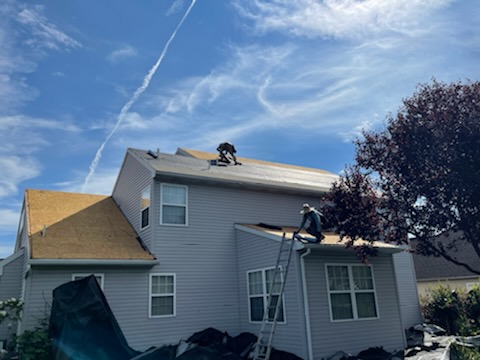
120 Sheppard Ln, Mohnton, PA
Scott Macczak quotes after that inspection rather than off a price list. Muthard Roofing in Temple, working since 1959, lists new slate installations and slate maintenance, with its contractor registration number printed on the site.
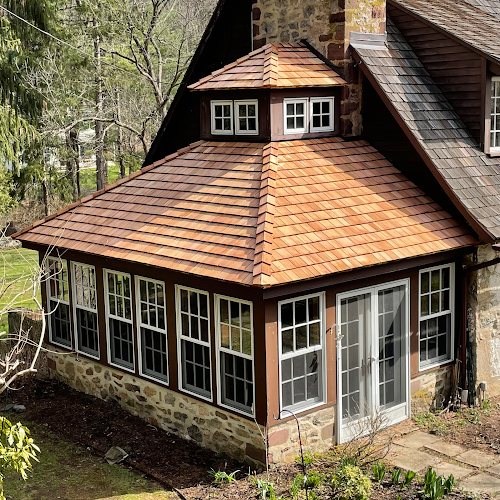
737 Peach Alley, Temple, PA
White & Sons Roofing Inc in Reading lists slate installation, repair, maintenance and restoration with 20-year workmanship warranties, and Ludwig Roofing and Repair LLC in the Bernville area lists slate installation with copper or stainless steel fasteners. Ask each the same five things: how many slate roofs a year, where matching slate comes from, copper or stainless for nails and flashing, hook ladders rather than feet on the slates (a ladder that hangs from hooks over the ridge, keeping the roofer's weight off the slates), and no roof cement. Then check the registration number; the post on how to verify a contractor's registration shows how. The rest of the county's roofers are on the county roofers page. Get a slate roofer up on a hook ladder before anyone talks about tearing it off.
Frequently asked questions.
Can you put shingles over a slate roof?
No, because the state code says a roof recover isn't permitted "Where the existing roof covering is slate," so the slate comes off first.
Why is my slate roof leaking if the slates look fine?
Because the slate is rarely the leak. Nails rust, flashings wear through, gutters back up, and attic condensation can wet a ceiling with no leak at all; the post on what roof leak repairs cost in Berks County explains why the stain is rarely under the hole.
Is my Berks slate roof the softer Pennsylvania kind?
If it's grayish black it may well be, since the Lehigh and Northampton slate is one of the main types on older slate roofs, though Virginia's gray-black slate is the hard, long-lived kind. Look at the face. The Pennsylvania slater who wrote the trade's reference book says smooth is good, flaking is usually a sign of wear, and ribbon slate, with a dark band of weaker rock across each piece, falls apart and can't be restored.
Sources
- National Park Service, Preservation Brief 29, "The Repair, Replacement, and Maintenance of Historic Slate Roofs" (Jeffrey S. Levine, 1993): repair rather than replace, the 20 percent rule, lifespans by slate type, flashings as the weakest point, nails failing first, false leaks, the repair method, board sheathing, and the maintenance schedule.
- Slate Roofing Contractors Association of North America, "Slate Roof Repair, Restoration, and Maintenance Guidelines" (version 1.1, September 2017): the slater's evaluation, five years of slate experience, the nail-and-bib method, no mastic, no face nailing, no straps, hook ladders, and valley flashings eroding sooner than others.
- Joseph Jenkins, Slate Roof Central, "How to Identify Your Roof Slate": Pennsylvania black slate at 75 to 125 years, Bangor and Chapman slate, ribbon slate, and smooth versus flaking faces.
- Traditional Roofing (Joseph Jenkins Inc.), Charles Silva, "Slate Roofing Costs" (2008): the two three-slate jobs priced at $250 and $2,500, and why the second cost ten times the first.
- Fixr, "Cost to Repair Slate Roof" (updated January 31, 2025): per-slate, nail, flashing, underlayment and repair-visit ranges, the specialist's inspection, labor per hour, and hook ladders.
- Fixr, "How Much Does a Slate Roof Cost in 2026?" (updated January 21, 2026) and "How Much Does an Asphalt Shingle Roof Cost in 2026?" (January 21, 2026): slate's weight per square, the half-the-cost rule of thumb, and architectural shingles per square foot.
- This Old House, "How Much Does A Slate Roof Cost?" (updated April 1, 2026): natural slate at $10 to $30 per square foot and $20,000 to $60,000 for 2,000 square feet, re-slating at $8 to $16 a square foot, synthetic slate per square foot, and hard and soft slate lifespans.
- Westlake DaVinci Roofscapes, slate roofing overview and Lifetime Limited Material Warranty (effective March 1, 2019): the maker's description of its composite slate and its warranty terms.
- Pennsylvania Residential Code 2021 (International Residential Code 2021 as adopted), Chapter 9, sections R905.6.1, R908.3.1.1 and R908.5: slate on solid sheathing, no new roof over slate, sound slate reinstalled and damaged slate not, rusted flashings replaced.
- U.S. Census Bureau, American Community Survey 2020-2024 five-year estimates, table B25034 (Year Structure Built), via Census Reporter: the share of homes built before 1940 in Berks County, Reading, West Reading and Wyomissing.
- Penn Slate Inc., Slatington, about and products pages (read October 31, 2026): two quarries in Pennsylvania's Slate Belt and roofing slates among the products.
- City of Reading, Historical Architectural Review Board, "Roof Replacement Guidelines" (adopted September 16, 2014): repair rather than replace, matching materials, in-kind replacement approved at staff level, and the financial-hardship submission for a different material.
- City of Reading, Historical Architectural Review Board page, Historic Preservation FAQs and Historic District Maps (read October 31, 2026): the four regulated districts and the Heights Conservation District, the certificate before the permit, the office at City Hall, the phone and email, the conservation-district rule, and the board's vacant seats.
- City of Reading Code of Ordinances, Chapter 295, Historical and Conservation Districts, sections 295-107, 295-110, 295-116 and 295-123: the certificate's reach to all visible exterior work, the conservation-district exemptions, roof-line changes to Council, financial hardship, and the $300-a-day summary offense.
- Reading Eagle, "City Council weighs future of historic preservation in Reading" (October 14, 2026): the board has no members; the six-month extension of the temporary process under which staff, administrators and Council review applications.
- Scott Macczak Roofing, Mohnton, slate roof repair page (read October 31, 2026): slate tile replacement, maintenance and emergency repairs, the free slate roof inspection, 51 years of roofing and the 10-year labor warranty.
- Muthard Roofing, Temple, slate roofing page and about page (read October 31, 2026): new slate installations and slate maintenance, "Year Established 1959" and "Licenses HIC#PA033391".
- White & Sons Roofing, Reading, slate roofers page (read October 31, 2026): slate installation, repair, maintenance, inspections and restoration, and 20-year workmanship warranties.
- Ludwig Roofing and Repair, Bernville, slate roof installation page (read October 31, 2026): slate installation with copper or stainless steel fasteners.
- Borough of Kutztown, boards and commissions list, Boyertown Borough, boards and West Reading Borough site (read October 2026): no historic architectural review board listed.