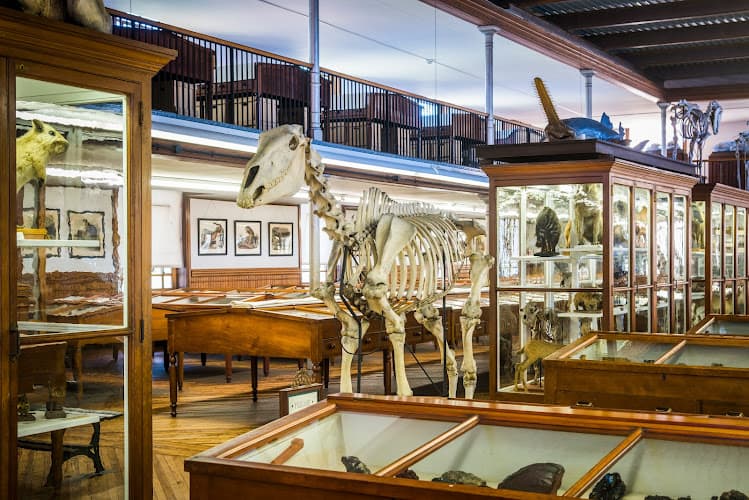
Wagner Free Institute of Science
The Wagner Free Institute of Science in Philadelphia is a museum dedicated to exploring natural history, offering unique exhibits and educational events.
What people love about Wagner Free Institute of Science
The Mineral and Crystal Collection
Multiple reviewers single out the mineral and crystal displays as particularly impressive, with one calling it the most beautiful they've ever seen, suggesting this is a standout feature of the collection.
Personalized One-on-One Tours
Several visitors highlight receiving personalized, nearly private tours from passionate staff, creating an intimate and memorable experience that larger museums cannot offer.
First Saturday Special Events (Mushroom Event)
The monthly First Saturday events, particularly the mushroom-themed programming, receive enthusiastic mentions as a unique draw that combines education with community engagement.
Exceptional Field Trip Experience with Staff Member Morgan
A specific staff member (Morgan) is praised by name for creating an outstanding educational experience for kindergartners, demonstrating the museum's strength in engaging young learners through hands-on dinosaur presentations.
Key Themes from Reviews of Wagner Free Institute of Science
Historic/Victorian Atmosphere & Preservation
PositiveCustomers consistently praise the museum's authentic 19th-century atmosphere and its remarkable preservation, describing it as a unique time capsule that transports visitors to the Victorian era.
Extensive & Diverse Collection
PositiveVisitors are impressed by the vast variety and quantity of specimens on display, including fossils, minerals, taxidermy, skeletons, and insects, often noting the collection exceeds expectations given the museum's modest exterior.
Free Admission & Accessibility
PositiveCustomers highly value the free admission model, viewing it as making quality science education accessible to all while encouraging donations to support the institution.
Staff Friendliness & Knowledge
PositiveReviewers consistently praise staff members for being welcoming, passionate, knowledgeable, and willing to provide personalized tours and answer questions.
Building Limitations (No AC, No Elevator, No Photography)
MixedWhile visitors generally accept these limitations as part of the historic building's character, some find the lack of air conditioning uncomfortable and the photography ban disappointing, though most understand the preservation rationale.
Educational Value & Programs
PositiveCustomers appreciate the museum's educational offerings, including free lectures, special events, school field trips, and interactive activities like scavenger hunts that engage both children and adults.
Hidden Gem/Underrated Destination
PositiveMany visitors describe the museum as a hidden gem that deserves more recognition, expressing surprise and delight at discovering such a unique attraction off the typical tourist path.
About Wagner Free Institute of Science
Overview
The Wagner Free Institute of Science is a natural history museum and educational institution located at 1700 W Montgomery Ave in the North Philadelphia neighborhood of the city. Founded in 1855 by William Wagner, a Philadelphia merchant and amateur scientist, the institute represents one of the oldest free science education centers in the United States. The organization operates as a women-owned institution and maintains its original mission of providing free scientific education to the public.
The museum occupies a purpose-built Victorian-era structure that has remained largely unchanged since its construction, offering visitors an experience that combines natural history specimens with architectural history. The building itself functions as a preserved artifact of 19th-century scientific practice and museum design, with original wooden display cases, hand-painted labels, and period-appropriate exhibition methods still in use today.
History and Founding
William Wagner established the institute during a period of intense public interest in natural sciences and popular education. Wagner, who had accumulated a substantial personal collection of natural history specimens, minerals, and fossils, created the institution with the explicit purpose of making scientific knowledge accessible to working-class Philadelphians who could not afford private education or admission fees to other museums.
The current building, completed in 1865, was designed specifically to house Wagner's growing collection and to accommodate the free public lectures that formed a central part of the institute's educational programming. The lecture hall, which remains in active use, has hosted scientific presentations continuously for over 170 years, making it one of the longest-running public lecture series in the country.
The institute predates many of the major natural history museums in the United States and represents an earlier model of scientific education that emphasized direct public engagement and democratic access to knowledge. Unlike museums that emerged later with corporate or government funding, the Wagner Free Institute was established as a charitable trust with the specific mandate that admission would always remain free.
Collections and Exhibitions
The museum houses approximately 100,000 specimens across multiple scientific disciplines, though not all are on public display at any given time. The permanent exhibition hall contains thousands of objects arranged in the taxonomic and systematic order that was standard practice in Victorian-era natural history museums. This organizational approach, while different from thematic or narrative-driven exhibitions common in contemporary museums, provides insight into how 19th-century scientists understood and categorized the natural world.
The collection encompasses several major categories of natural history specimens:
- Minerals, crystals, and geological specimens, including materials sourced from Pennsylvania and the broader mid-Atlantic region
- Paleontological materials including fossils from various geological periods
- Taxidermied mammals, birds, and reptiles representing species from multiple continents
- Skeletal preparations and anatomical specimens
- Entomological collections featuring preserved insects and invertebrates
- Malacological specimens including shells and mollusks
- Botanical materials and preserved plant specimens
- Eggs and nests from various bird species
The mineral and crystal collection is particularly extensive, featuring specimens that demonstrate geological processes and the diversity of mineral formations. Many of the geological specimens were collected during the 19th century when Pennsylvania's mining industry was at its peak, providing documentation of mineral resources that may no longer be accessible.
The taxidermy and skeletal collections include both common North American species and exotic animals that would have been rare and remarkable to 19th-century Philadelphia audiences. These specimens, while prepared using historical techniques, continue to serve educational purposes and provide physical reference materials for understanding animal anatomy and diversity.
Educational Programming
The Wagner Free Institute maintains an active schedule of educational programs that extend beyond the static museum displays. The institute offers guided tours of the collection and building, providing context for both the scientific content and the historical significance of the institution itself. Tours are available as part of regular operations, and visitors often receive personalized attention given the museum's more intimate scale compared to larger institutions.
The lecture hall continues to host free public presentations on scientific topics, maintaining the tradition established by William Wagner in the 1850s. These lectures cover a range of subjects in natural history, environmental science, and related fields, typically delivered by researchers, academics, and science educators.
The institute operates special programming on First Saturdays, offering themed events that combine educational content with interactive activities. These monthly programs address specific topics in natural history and often include hands-on components designed to engage younger visitors. Past programming has included events focused on mycology, local ecology, and specimen study.
School groups and organized educational visits are accommodated through the institute's group programming. Staff members conduct demonstrations and interactive sessions in the lecture hall, using specimens from the collection to illustrate scientific concepts. These programs are designed to align with educational standards while taking advantage of the unique resources available at the museum. Activity materials including scavenger hunts and worksheets are available to help younger visitors engage with the collection independently.
Visitor Information and Facilities
Admission to the Wagner Free Institute of Science is free, consistent with the founder's original mandate. The institution operates on a donation-based model, encouraging but not requiring contributions from visitors to support ongoing operations and preservation efforts.
The museum provides basic visitor amenities including restroom facilities. A wheelchair accessible restroom is available. The building, as a preserved historic structure, does have certain physical limitations typical of 19th-century architecture. A gift shop offers merchandise and educational materials related to the collection and natural history topics.
The museum is appropriate for visitors of various ages, with programming and collection content that can engage both children and adults. Families with young children will find the diverse specimen collection accessible, and staff members are available to answer questions and provide context for the displays.
Photography policies and other visitor guidelines are in place to support the preservation of the historic building and collection. Visitors should be prepared for conditions consistent with a preserved historic structure, which may differ from climate-controlled modern museum environments.
Location and Community Context
The Wagner Free Institute is situated in North Philadelphia, outside the concentration of tourist attractions in Center City and the historic district. The location reflects the institute's original mission of serving the surrounding community rather than attracting tourism. The neighborhood context places the museum within reach of residential areas that have historically benefited from the free educational programming.
The building's address on Montgomery Avenue places it within reasonable distance of public transportation options serving North Philadelphia. The institute's position away from heavily trafficked tourist areas means that visitors often encounter a quieter, more contemplative museum experience with opportunities for extended examination of specimens and unhurried conversation with staff.
Institutional Significance
The Wagner Free Institute holds designation as a National Historic Landmark, recognizing both its architectural significance and its role in the history of American science education. The building and its contents together represent a remarkably complete example of Victorian-era museum practice, preserved not as a recreation but as a continuously operating institution.
For researchers and historians, the institute provides primary documentation of 19th-century scientific collecting practices, taxonomic systems, and public education methods. The collection itself, while no longer on the cutting edge of scientific research, retains value as historical documentation of species distribution, geological resources, and natural history knowledge as it existed during the period of collection.
The institute's survival as a free public institution for over 165 years represents an unusual case in American museum history, where many similar institutions either closed, merged with larger organizations, or transitioned to admission-based models. The Wagner Free Institute's continued operation under its original mandate provides a functioning example of 19th-century ideals about democratic access to scientific knowledge.
Unique Details About Wagner Free Institute of Science
Crowd
- Family-friendly
Other
- Identifies as women-owned
Children
- Good for kids
Amenities
- Restroom
- Offers tours
Offerings
- Gift shop
Highlights
- Live performances
Accessibility
- Wheelchair accessible restroom
Service options
- Onsite services
From the business
- Identifies as women-owned
Contact Information for Wagner Free Institute of Science
Philadelphia, PA 19121
United States of America
County: Philadelphia County
Phone: +1 215-763-6529
Website: Visit Website
Customer Reviews
4.8 out of 5 stars
Based on 112 reviews
Review data
5 star reviews
- 89%
4 star reviews
- 8%
3 star reviews
- 1%
2 star reviews
- 2%
1 star reviews
- 0%
Working Hours / Hours of Operation
- Monday:
- Closed
- Tuesday:
- 9:30AM-4:30PM
- Wednesday:
- 9:30AM-4:30PM
- Thursday:
- 9:30AM-4:30PM
- Friday:
- 9:30AM-4:30PM
- Saturday:
- Closed
- Sunday:
- Closed
Location Map
BerksConnect: everything local in Berks County, PA.
8,700+ local businesses with AI-summarized reviews, plus local guides, jobs, and what's happening around the county.