Does My Berks County House Need a Surge Protector?
Whether a Berks County house needs a whole-house surge protector, what one costs installed, the code rule that puts one on every new panel, and who should wait.
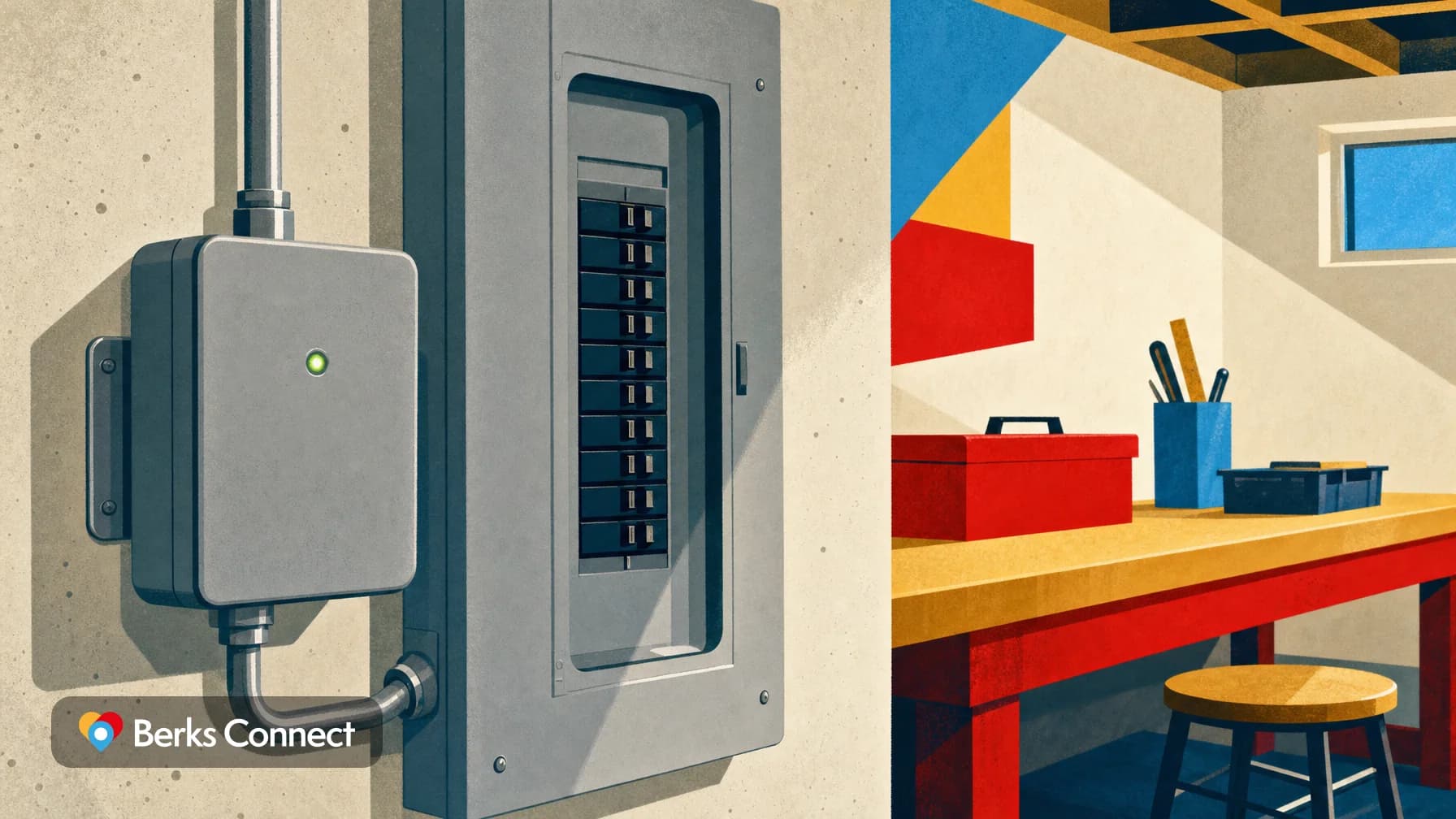
Yes, if you own the house and it has a furnace or heat pump, a central air conditioner, a water heater, a well pump, or anything else wired straight into the panel. A whole-house surge protector is a few hundred dollars installed, and it's the kind of protection that covers those. If a surge protector is already a line item on a panel-upgrade quote you're holding, keep it, because Pennsylvania's building code now requires one with every new main panel. If you're not replacing the panel, an electrician from the county electricians page can add one to the panel you have in a couple of hours.
Does my Berks County house need a surge protector, or are power strips enough?
You might be thinking the strips behind the TV already have this covered. They cover what's plugged into them, and nothing else. A whole-house surge protector is a small box wired into the main electrical panel, or mounted right beside it, and its job is to catch a burst of extra voltage on the incoming power line before it reaches the house's wiring.
So what does it cover that the strips can't? Everything you can't put on a strip. The furnace or heat pump, the air conditioner, the water heater, a well or sump pump, an EV charger, the oven and the washer are wired straight into the house or plug into an outlet no strip can serve. There's no strip to put them on, and they're the most expensive electrical things you own.
The two layers work together, and neither replaces the other. The panel unit takes the big hits at the front door. The strips stay on the television, the computer and anything with a cable or internet line into it. A surge can ride in on the cable or internet line, and the panel unit only guards the power line.
Where the surges in a Berks County house come from.
A surge is a brief burst of extra voltage, more than the wires were meant to carry. Lightning striking near the power, phone or cable lines is the one everybody pictures. Surges also come from the utility's own switching, from power coming back on after an outage, and from the big motors and compressors inside your own house cycling on and off.
That last one surprises people. As many as 80 percent of power disturbances start inside the home, and the biggest culprits are the appliances with motors or compressors that cycle on and off all day: the heating and air conditioning, the refrigerator, the washing machine, the pumps. Those surges are small, but they repeat, and they wear electronics down over time.
Berks gets the storms that cause the surges from outside the house. On July 28, 2026, a quick-moving storm left more than 2,000 Met-Ed customers in the county without power at one point. On July 1, 2025, the storm that put a tornado down in Amity Township knocked out electricity for more than 10,000 customers. Every outage ends with the power coming back on, which can send a surge of its own.
Nothing you can buy stops a direct lightning strike. What a panel unit and the strips handle is the surge that arrives on the wires from a strike some distance away, or from the grid. And if the storm left you with a breaker that won't stay reset, that's a different problem, and our post on a breaker that keeps tripping walks through it.
Can a power surge damage a furnace or heat pump?
Yes, and this is why the question matters more than it did twenty years ago. A modern heat pump is run by a control board, a circuit board that can't be repaired if a surge damages it, only replaced. A surge can leave the system partly or fully dead. That can be one big surge from a storm or a series of small ones over years of cycling.
So is the protector worth it? Put the two facts side by side. A whole-house unit is a few hundred dollars. The board inside your heat pump can't be fixed, only swapped. I'd rather pay for the box than find out what a board costs.
Pennsylvania's building code now requires a surge protector with a new panel.
If your panel-upgrade quote has a surge protector on it, this is why. Pennsylvania's adoption of the 2021 residential code took effect on January 1, 2026, and that code says the main line bringing power into a one- or two-family house, what the code calls the service, gets a surge-protective device, which is what the quote may call an SPD. It's built into the main panel or mounted right next to it, and the same rule applies whenever the main panel gets replaced.
So a house getting a new main panel in Berks gets a surge protector with it. That line item is part of doing the job to code. What the panel itself costs is its own question, and our panel upgrade cost post answers it.
What a whole house surge protector costs installed.
The prices here are for the usual unit that mounts at or beside the panel, which the quote may call a Type 2. The device is usually the smaller part of the bill; the rest is an electrician's time for a job that takes a couple of hours. This is what the job runs nationally, as of 2026:
| What you're paying for | National range |
|---|---|
| The device itself (a Type 2 panel unit) | $60 to $300 |
| Installed by an electrician, device and labor | $200 to $450, with about $300 the typical job |
The typical job lands around $300 for the device and the labor. The labor is what moves the price from one electrician to the next; what electricians charge per hour here covers it.
There's usually a permit on top. Adding wiring to a house is more than an ordinary repair under the state's rules, and this job adds a breaker and connections inside the panel. So it needs a permit, and your electrician can file it for you as your agent. When the unit goes in with a panel replacement, it rides on that job's permit. The fee is each township's own number, not a county rate, so ask your electrician what your town charges. Two examples: Spring Township charges $90 per inspection plus a $4.50 state fee for an electrical alteration; Exeter Township charges a flat $200 plus $4.50 for residential electrical work.
How to tell whether your house already has one, and who should wait.
Before you book anyone, look at the main panel. A house that already has a surge protector will usually have a small box on the panel or right beside it with a status light. Green means it's working, and the standalone job in this post isn't for you. If there's no box and no light, ask the electrician to check the panel and the meter when they come.
Who should wait? Two cases. If you rent, the panel belongs to the property owner and so does the permit. Plug-in strips are the part you can do yourself; the panel unit is a conversation with the landlord. If the house is still on a fuse box or a panel that's due for replacement, the panel job comes first. By code the new panel includes the surge protector, so it comes with that job rather than as a separate visit.
How a whole-house surge protector gets installed.
Once you've decided, pick an electrician from the county electricians page, say you want a whole-house surge protector at the panel, and ask two things when they call back.
First, ask them to check the panel's grounding and its neutral-to-ground bond before the unit goes in. The most common reason a surge protector fails early is a bond that isn't right, so a good electrician checks both first. If something's missing or faulty, fixing the grounding runs $100 to $700 nationally.
Second, ask about the permit; your electrician can file it for you as your agent, and the fee goes on the bill. The visit itself is a couple of hours. When they're done, you'll see the status light on the new box, green while the unit is working. The unit wears out over time, and it tells you when it's done: the green light goes out, a red light flashes or an alarm sounds. Then you call for a replacement.
That's the decision. If you own the house and anything in it is wired straight in, get the box on the panel. If it's already a line item on your panel-upgrade quote, keep it and sign.
Common questions.
Does homeowners insurance cover surge damage?
Sometimes, and your own policy decides. The standard homeowners form covers lightning damage and sudden electrical damage to your belongings. For the electrical-current peril it leaves out the electronic parts inside appliances, computers and home entertainment gear. Those are the parts a surge usually destroys, so ask your agent, and how a homeowners policy treats the heating and cooling system covers the heating and cooling side.
How do I know when a whole-house surge protector needs replacing?
Look at the light. It stays green while the unit is working. When the green light goes out, a red light flashes or an alarm sounds, the unit has taken enough hits and it's time for a new one.
Will a whole-house surge protector protect my house from lightning?
Not from a direct strike; nothing sold for a house does that. The panel unit handles the surge that comes in on the wires from a strike some distance away, or from the grid.
Do I still need power strips if I have a whole-house surge protector?
Yes, on the television, the computer and anything with a cable or internet line into it. A surge can arrive on the cable or internet line, and the panel unit only guards the power line.
Sources
- National Institute of Standards and Technology, "Surges Happen! How to Protect the Appliances in Your Home" (Special Publication 960-6, May 2001): what a service-entrance protector does, the two kinds of surge, and why appliances with a cable or phone line still need a plug-in unit.
- Square D by Schneider Electric, "Home Surge Protection": the equipment a panel unit covers that a plug strip cannot.
- Met-Ed / FirstEnergy, "Troubleshooting Electrical Problems" (last modified August 19, 2025): as many as 80 percent of power disturbances originate inside the home, the motor and compressor culprits, and that suppression devices wear over time.
- FirstEnergy, "Surge Assist FAQs": the causes of a surge, including power coming back on after an outage.
- National Weather Service, "Lightning Safety Indoors": surges from a strike some distance away, and that typical surge protectors will not protect equipment from a lightning strike.
- NYSERDA Clean Heat Connect, "Heat Pumps: Protection from Surges" (May 2024): control boards in modern heat pumps, damage from one big surge or many small ones, and that a damaged board is replaced, not repaired.
- Pennsylvania Code, 34 Pa. Code § 403.21, "Uniform Construction Code" (amended November 7, 2025, effective January 1, 2026): Pennsylvania's adoption of the 2021 International Residential Code, with no exclusion of its surge protection section.
- International Residential Code 2021 as adopted in Pennsylvania, Chapter 36, Section E3606.5 "Surge Protection" (UpCodes): the requirement for a Type 1 or Type 2 surge-protective device on every service to a one- or two-family house, its location, and the rule that it applies when service equipment is replaced.
- HomeGuide, "How Much Does a Whole-House Surge Protector Cost?" (2026): the Type 2 unit-only and installed ranges, and the cost to correct missing or faulty grounding.
- HomeAdvisor, "How Much Does a Whole-House Surge Protector Cost?" (updated June 19, 2026): the roughly $300 typical installed cost and the couple of hours the job takes.
- Pennsylvania Code, 34 Pa. Code § 403.62, "Permit requirements and exemptions": that adding electric wiring is not an ordinary repair, and that the permit is the owner's or the owner's agent's to obtain.
- Spring Township, "2026 Fee Schedule" (Resolution 2026-05): the $90 per inspection electrical alteration fee and the $4.50 state fee.
- Exeter Township, "2023 Fee Schedule" (revised December 22, 2022): the $200 residential electrical permit fee and the $4.50 state fee.
- Siemens, "FirstSurge Whole House Surge Protection" (product flyer, 2015): the green and red status lights and audible alarm, and neutral-to-ground bonding faults as the leading cause of surge protector failure.
- WFMZ, "Quick-moving storm leaves severe damage across Berks County" (July 28, 2026): more than 2,000 Met-Ed customers in Berks without power at one point.
- Reading Eagle, "Tornado confirmed in southern Berks Tuesday" (July 3, 2025): the July 1, 2025 tornado in Amity Township and more than 10,000 Berks customers without electricity.
- Insurance Services Office, "Homeowners 3 Special Form" (HO 00 03 05 11, filed copy): lightning and sudden and accidental damage from artificially generated electrical current as named perils for personal property, and the carve-out for electronic components inside appliances and electronics.