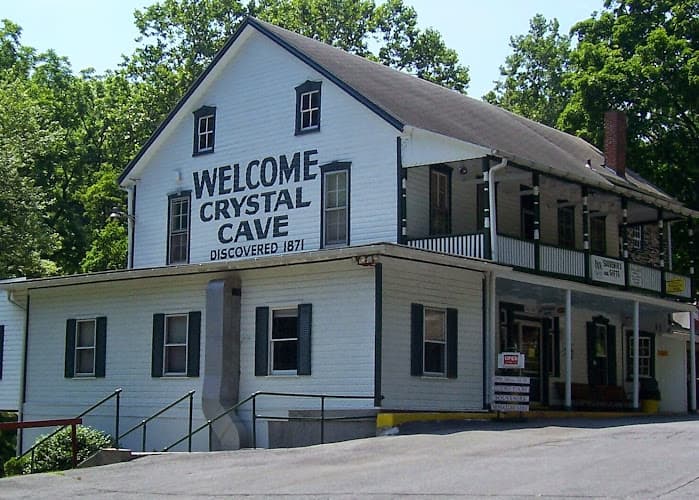
Crystal Cave is a limestone show cave and visitor complex at 963 Crystal Cave Road in Kutztown, Pennsylvania, in northern Berks County. The property combines guided underground tours with a cluster of aboveground attractions set on wooded hillside acreage, including a gift shop, picnic grounds, a nature trail, miniature golf and a gemstone panning sluice. It operates as a seasonal tourist attraction, drawing school groups, scout troops, families and travelers passing through the Oley Valley and Pennsylvania Dutch countryside. The main telephone line is +1 610-683-6765.
History and Geology
The cave was found in 1871 by quarry workers cutting limestone on a farm in the hills above what is now Virginville Road, and it was opened to paying visitors the following year. That early opening makes it one of the oldest commercially operated caves in Pennsylvania, and the site has functioned as a public attraction for most of the time since, under a succession of owners who added buildings, lighting and improved walkways to the original rough passage.
Geologically, the cave formed in Ordovician limestone through the slow dissolution of rock by groundwater, a process that left behind chambers decorated with calcite formations. Visitors see stalactites hanging from ceilings, stalagmites rising from the floor, columns where the two have joined, flowstone sheets, draperies and the crystalline deposits that gave the cave its name. Guides point out named features that earlier generations of visitors recognized by shape, a tradition common to show caves of the nineteenth century. Because the cave is still geologically active in places, water seeps along walls and ceilings, and formations continue to grow at a rate measured in fractions of an inch over long spans of time.
The Guided Tour
Entry to the cave is by guided tour only, and tours leave on a rolling schedule through the operating day. Before heading underground, groups watch a short orientation film in an on-site theater that covers how the cave was discovered, how limestone caverns form and what to expect along the route. The film gives context that guides then build on during the walk itself, so geology terms and historical details introduced on screen come up again at the formations they describe.
The underground portion generally runs about three quarters of an hour. The route follows paved and lighted walkways through a series of connected chambers, with staircases and handrails where the passage changes elevation. Guides narrate throughout, covering formation names, the cave's discovery story, the behavior of groundwater and the history of early tourism at the site. Most tours include a brief lights-out moment so visitors can experience complete darkness, an effect that is impossible to reproduce aboveground and that tends to be remembered long after the rest of the tour.
The cave holds a steady temperature in the mid-50s Fahrenheit year round, regardless of the weather outside, so a light jacket or sweatshirt is sensible even on hot summer days. Walkways can be damp, and closed-toe shoes with reasonable traction are the practical choice.
Aboveground Attractions
The grounds surrounding the cave entrance are laid out so that a visit can fill several hours rather than the length of a single tour. Features typically available during the season include:
- A gemstone panning sluice, where visitors work a bag of rough material through screens and running water to recover polished stones, fossils and mineral specimens. This is a separate add-on activity and is particularly popular with children.
- A miniature golf course set among the trees on the property.
- A marked nature trail that climbs through the woods above the cave entrance, with views over the surrounding farmland.
- Picnic tables and shaded outdoor seating, suitable for groups that bring their own food.
- Food service on site, including snacks, ice cream and light refreshments.
- A rock and mineral museum display area that explains the regional geology and shows specimens related to the cave.
Gift Shop
The main building houses a large gift shop that doubles as the waiting area and ticket counter. Its stock leans heavily toward rocks, minerals, fossils, geodes and polished stones, along with jewelry, educational toys, books on caves and geology, and standard souvenir items. Price points run from pocket-money purchases for children to larger specimen pieces, and the shop is open to anyone on the property, including those waiting for a tour time or accompanying a group without going underground.
Practical Information for Visitors
Crystal Cave operates seasonally, with the schedule running roughly from spring through late autumn and the fullest hours falling in summer. Days and hours vary by month, and the site also runs special evening and holiday programs at certain points in the calendar, including lantern-style tours with a historical and folklore theme. Calling ahead at +1 610-683-6765 is the surest way to confirm the day's schedule, tour departure times and whether any special events are running.
Parking is free in an on-site lot, and accessible parking spaces are provided. Visitors should note that the cave itself is reached by a walkway with a significant number of steps and changes in grade, which limits access for strollers, wheelchairs and anyone with difficulty climbing stairs. The gift shop, theater area and much of the surrounding grounds are easier to navigate. Families often split the visit, with some members touring the cave while others use the picnic area or shop.
Group and school rates are available, and the site handles field trips, scout outings, birthday parties and bus tours. Busier days, especially summer weekends and holidays, can mean a wait between ticket purchase and tour departure, which is a reasonable time to pan for gems, play a round of mini golf or walk the trail. Quieter weekdays in the shoulder season often mean small groups and a more conversational tour.
Location
The attraction sits on Crystal Cave Road northwest of Kutztown, a short drive from Route 222 and within easy reach of Allentown, Reading and the Lehigh Valley. The approach runs through farmland and rolling hills typical of Berks County, and the site pairs naturally with other regional stops such as Kutztown's shops and university district, nearby covered bridges and the farm markets of the surrounding townships.